+603 – 9281 1999 | council@mtc.com.my

+603 – 9281 1999 | council@mtc.com.my

[searchwp_form id="1"]

Timber Export Statistics

Timber Export Statistics

Sustainable Growth in Timber Exports

Explore the latest timber export statistics, sourced from DOSM and MTIB, to gain valuable insights into the industry’s growth, trends, and sustainable development. Stay informed and ahead in the ever-evolving timber market.

2025

2024

2023

2022

2021

2020

2019

2018

2017

2016

2015

2014

2013

2012

2011

2010

2024

2023

2022

2021

2020

2019

2018

2017

2016

2015

2014

2013

2012

2011

2010

2009

2008

2007

Timber Export Statistics

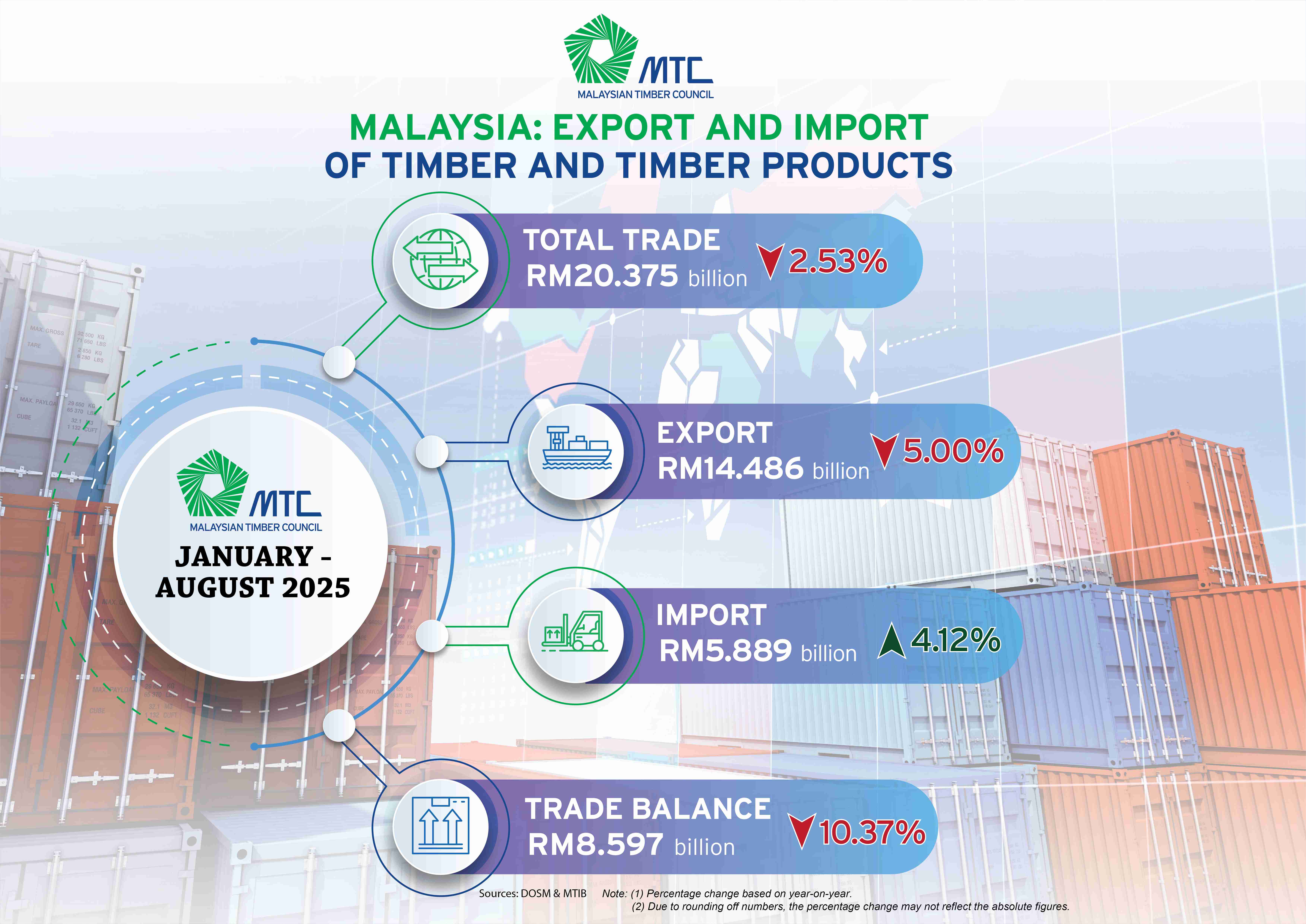
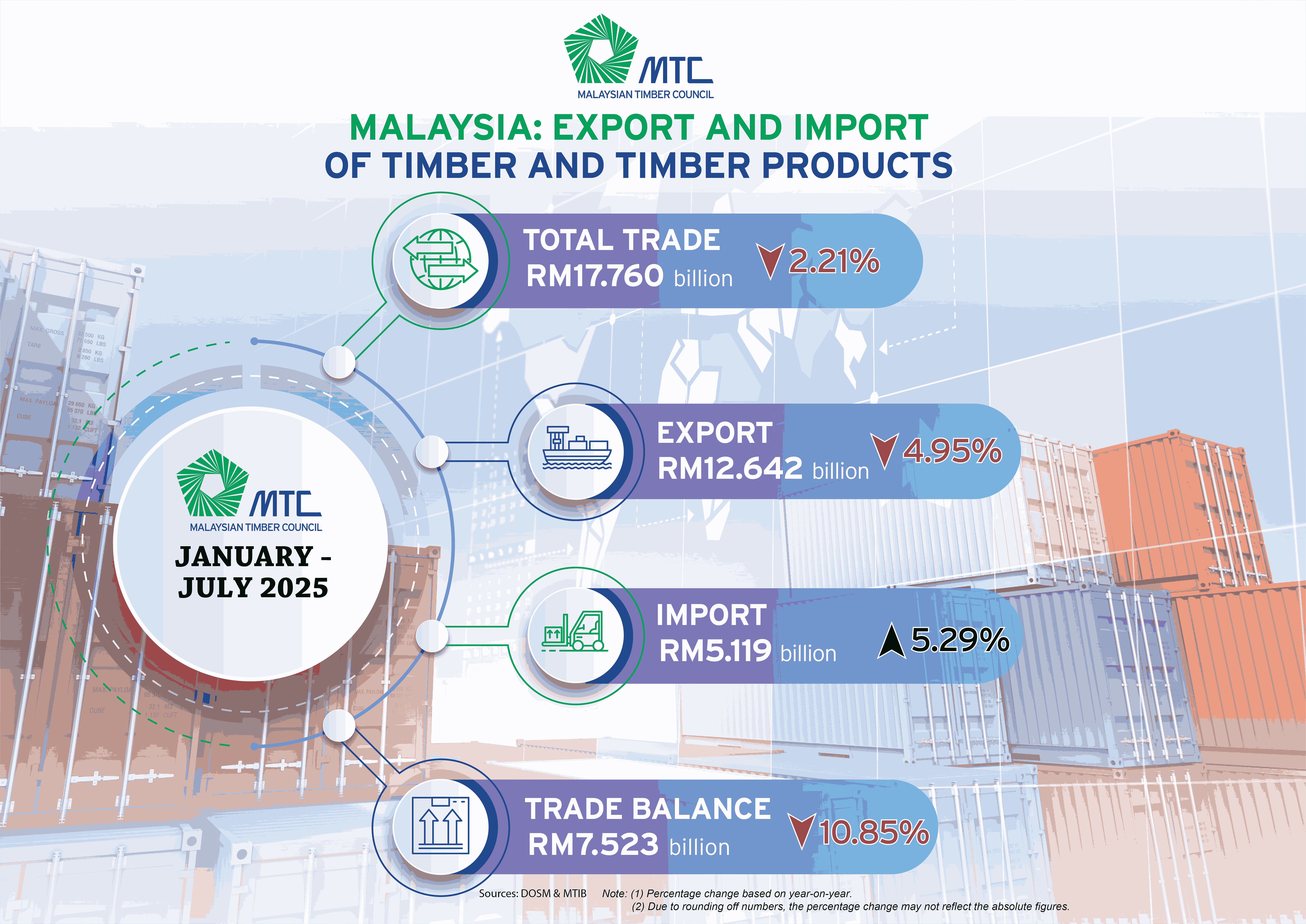
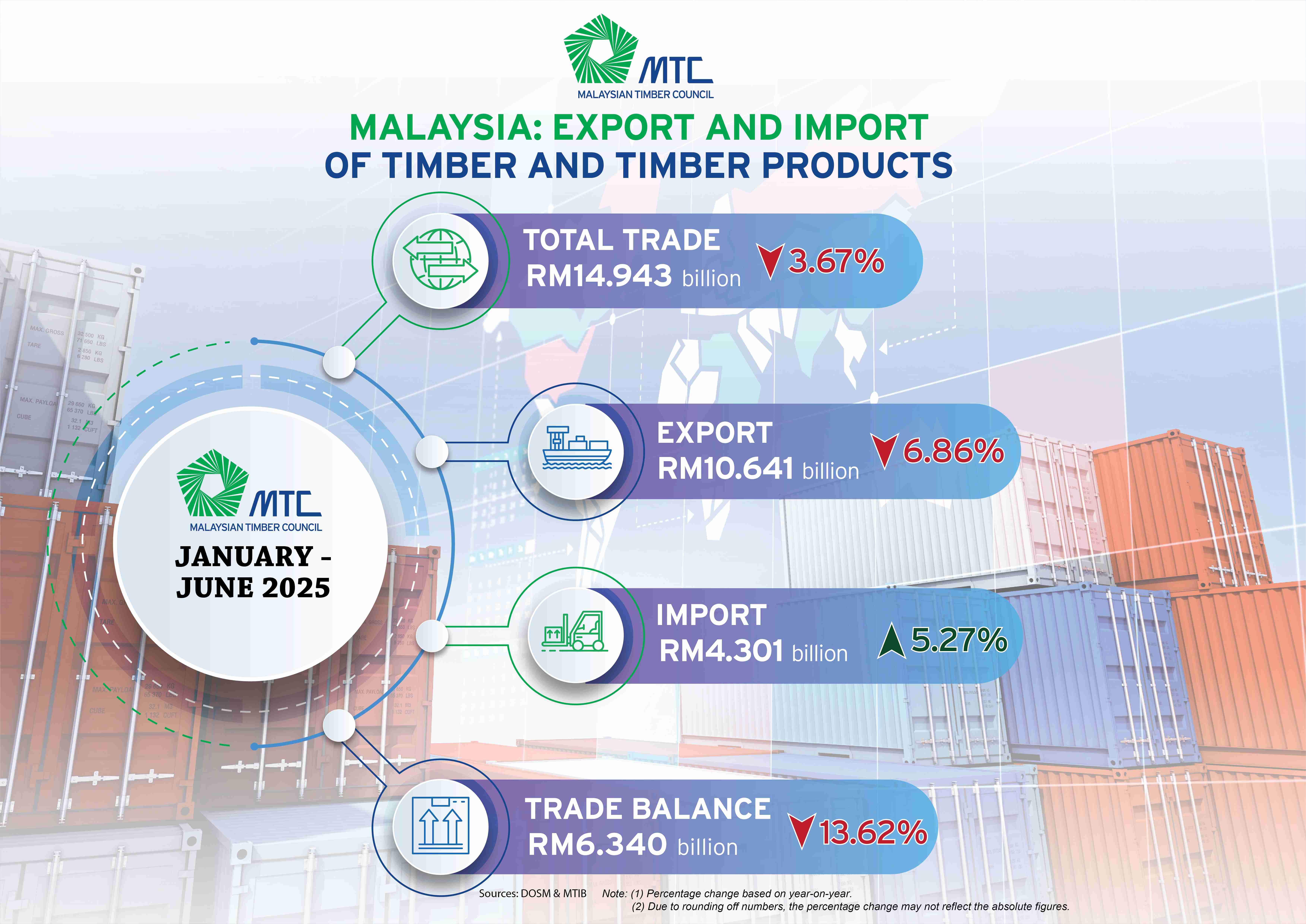
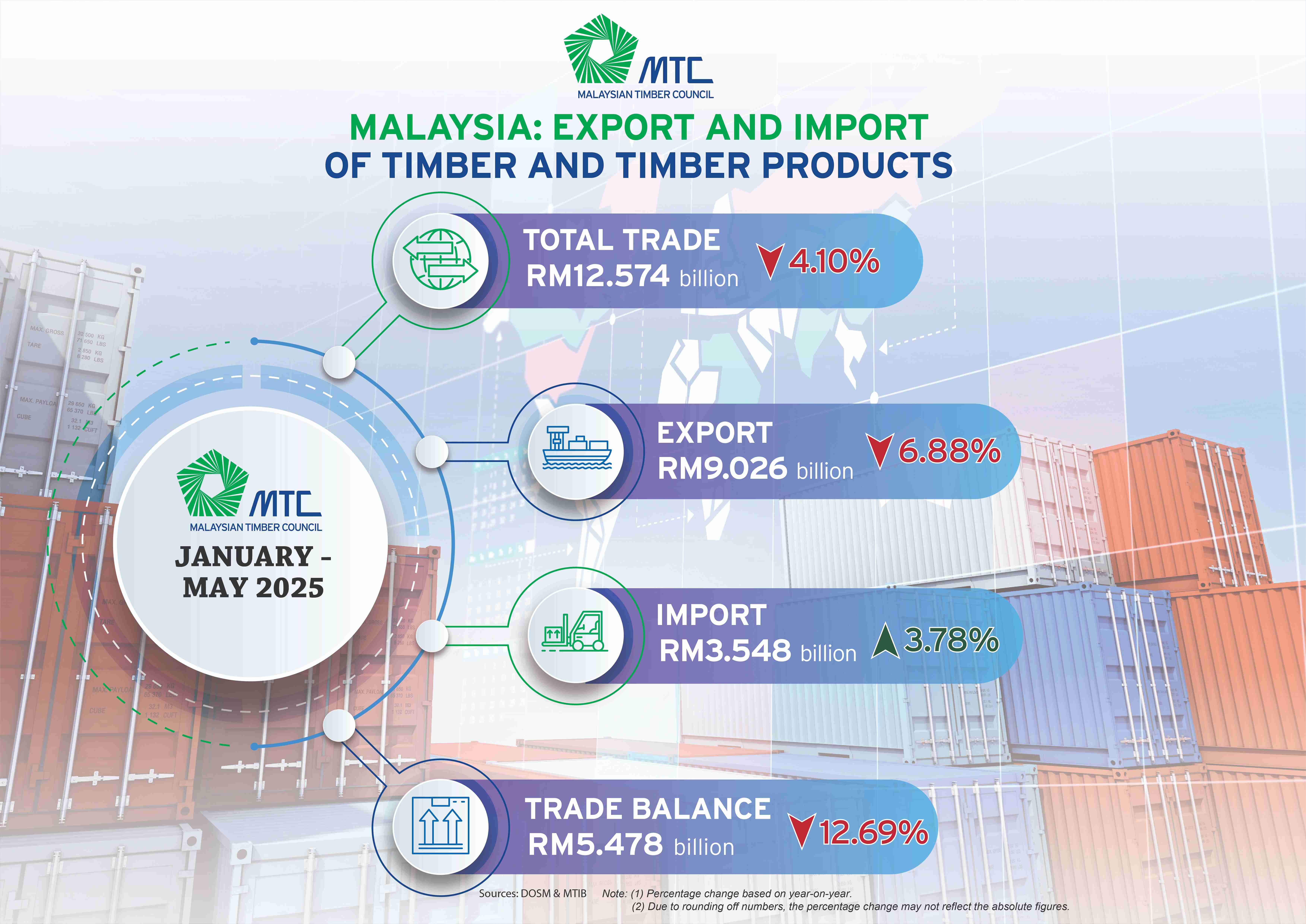
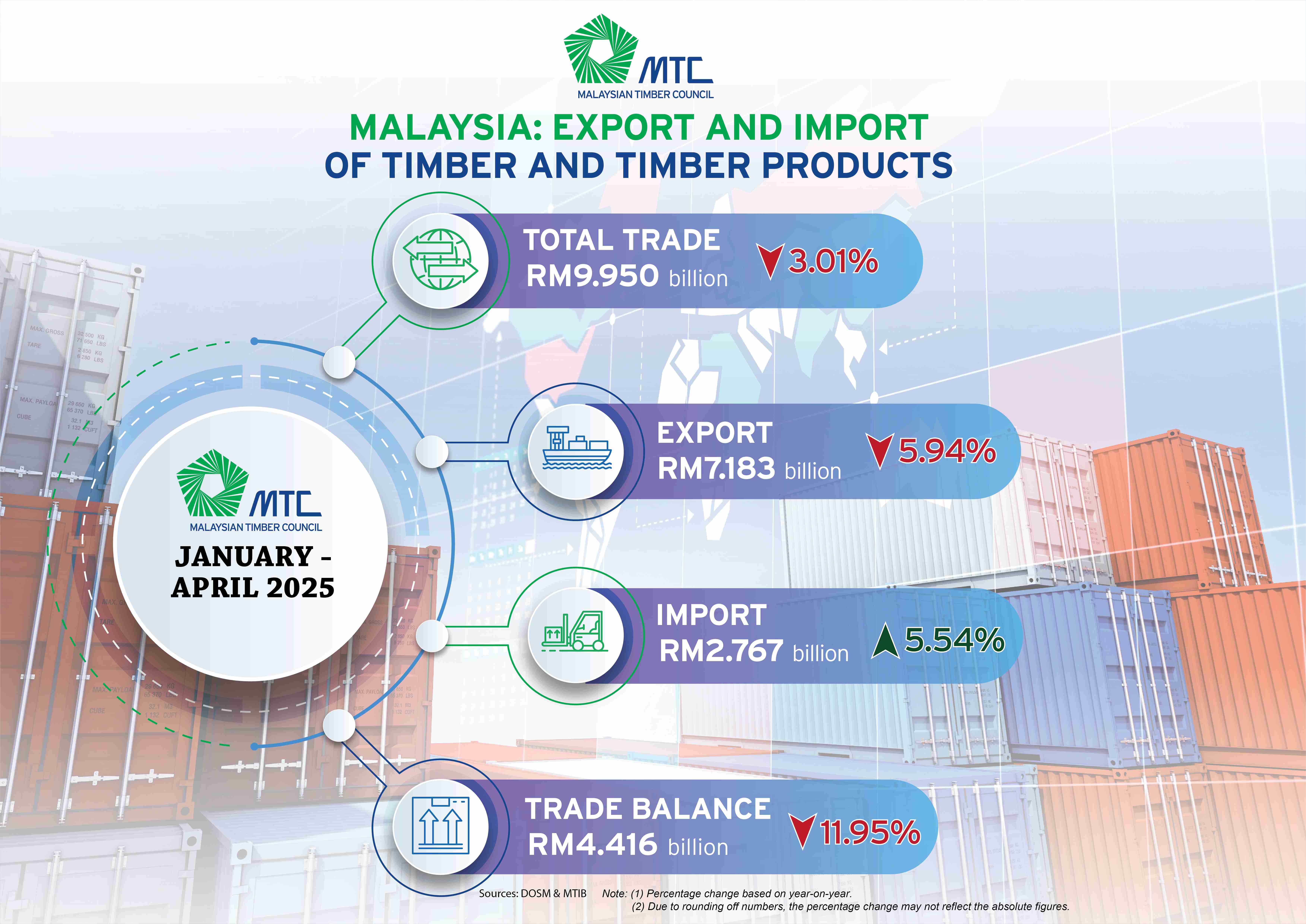
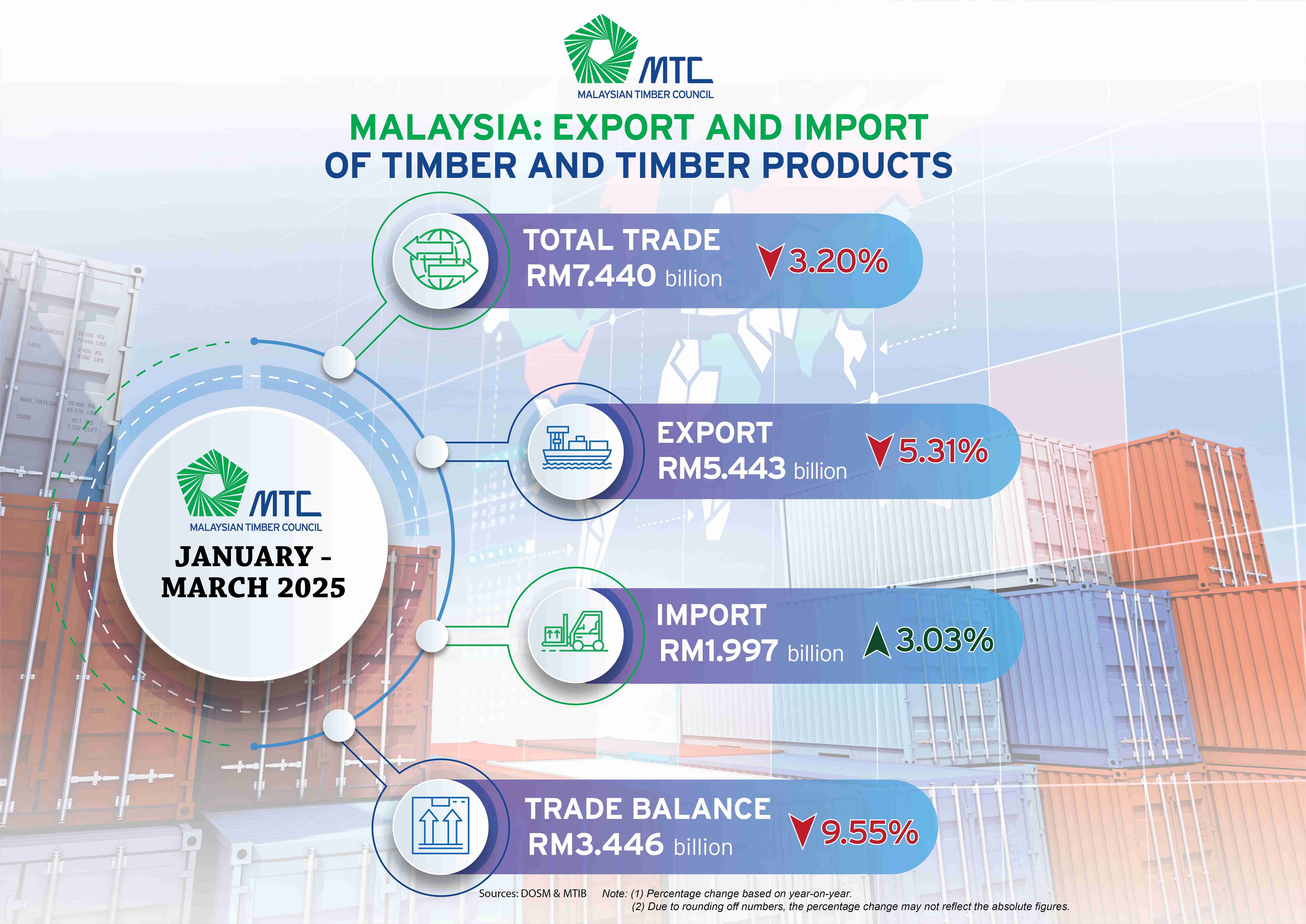
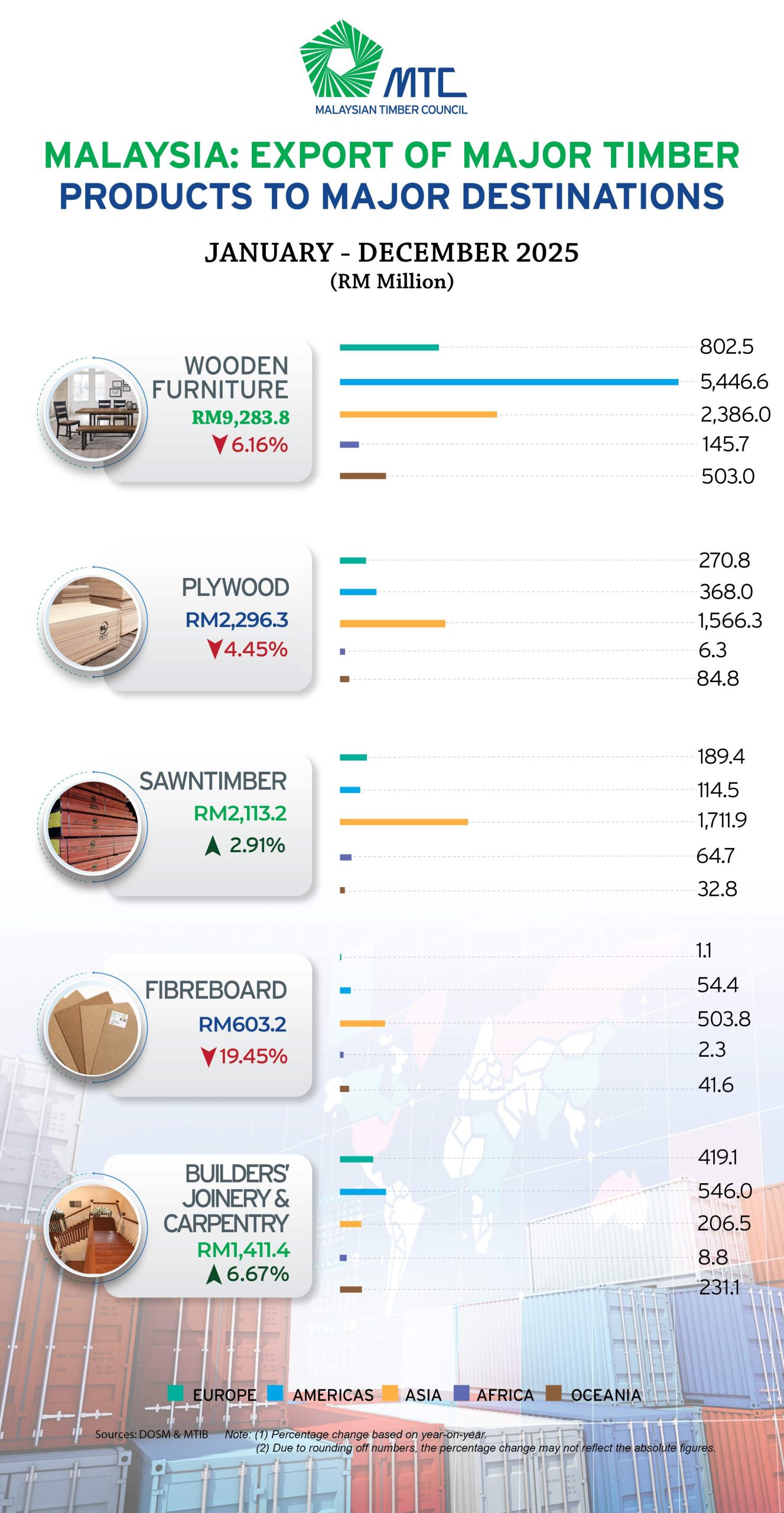
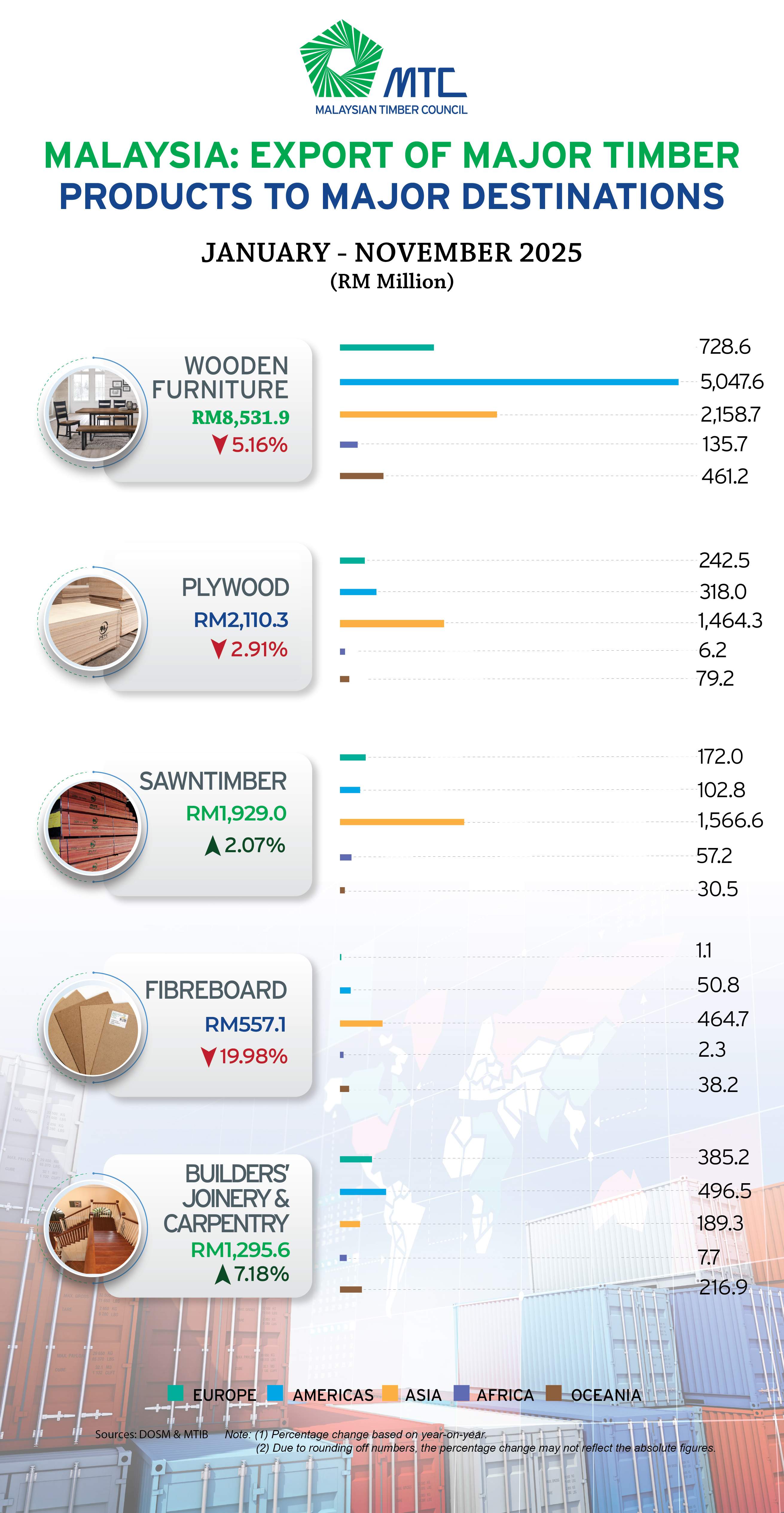
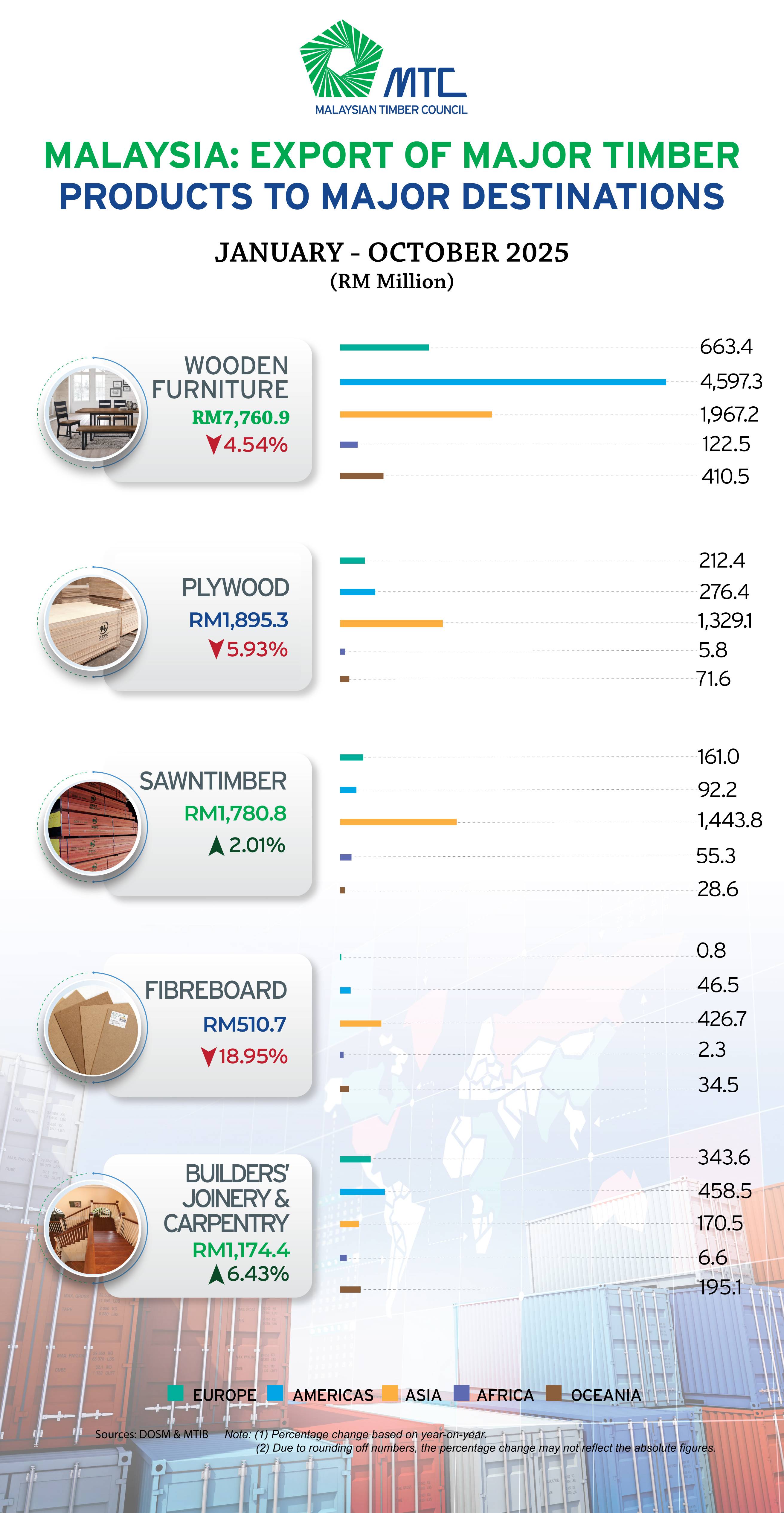
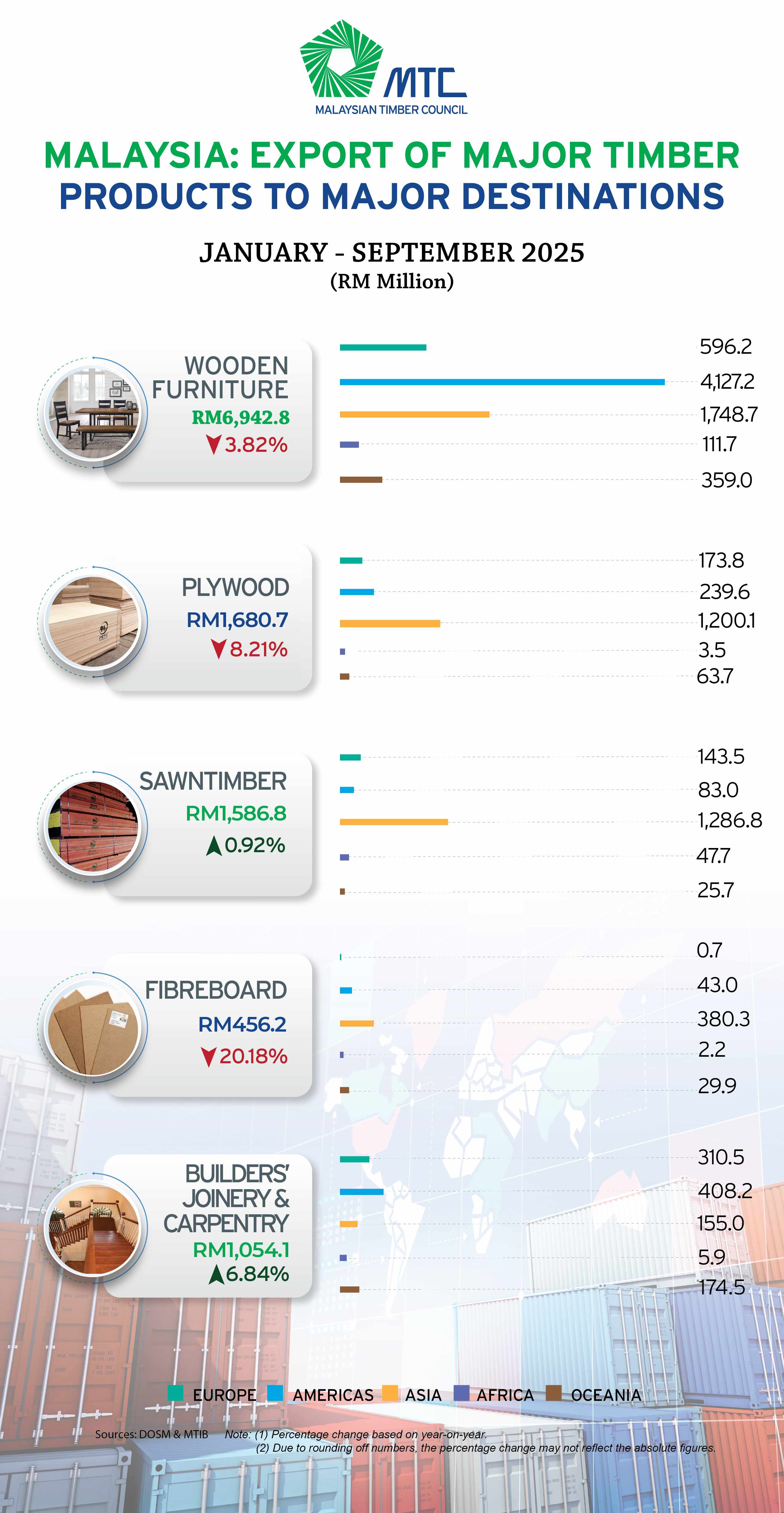
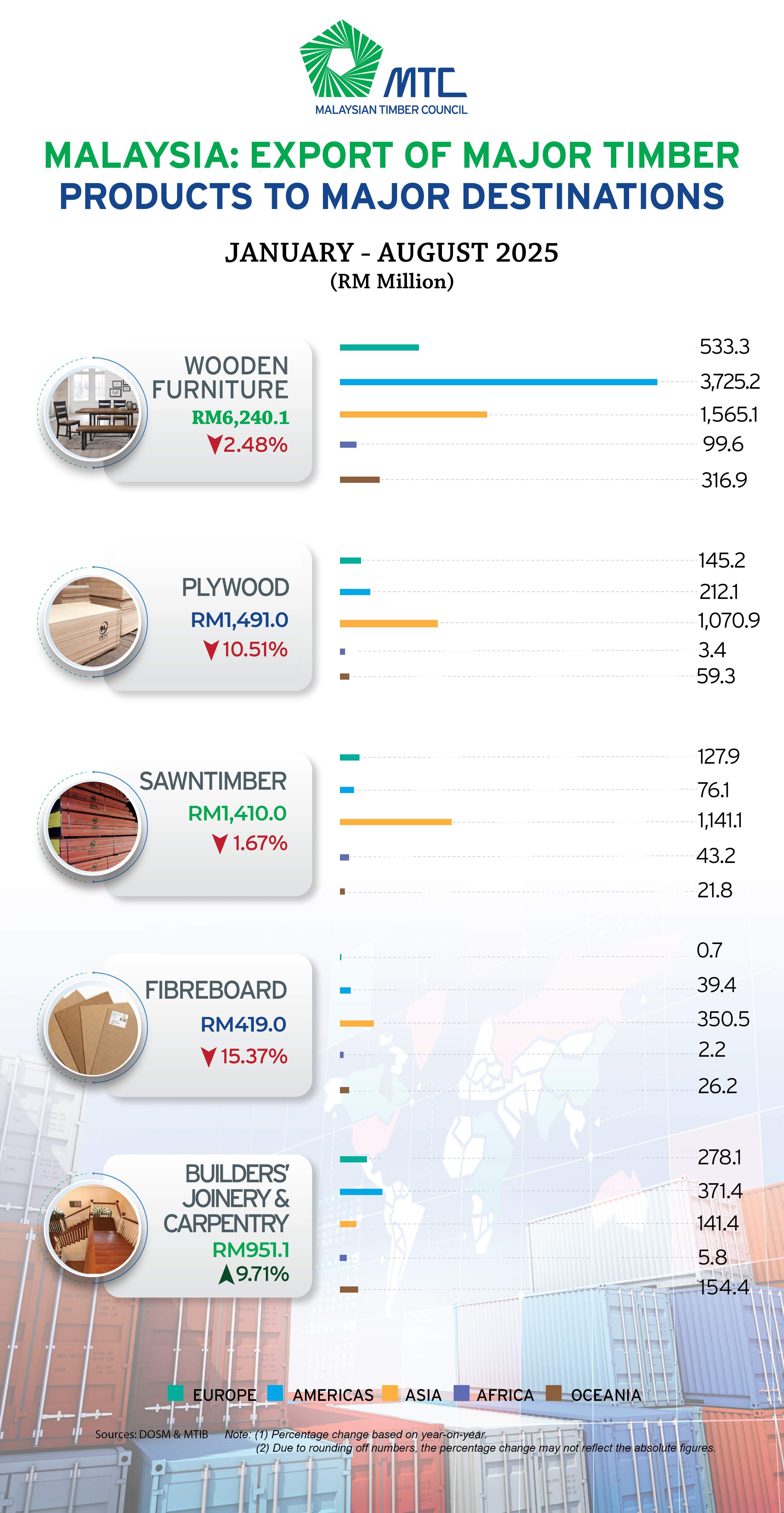
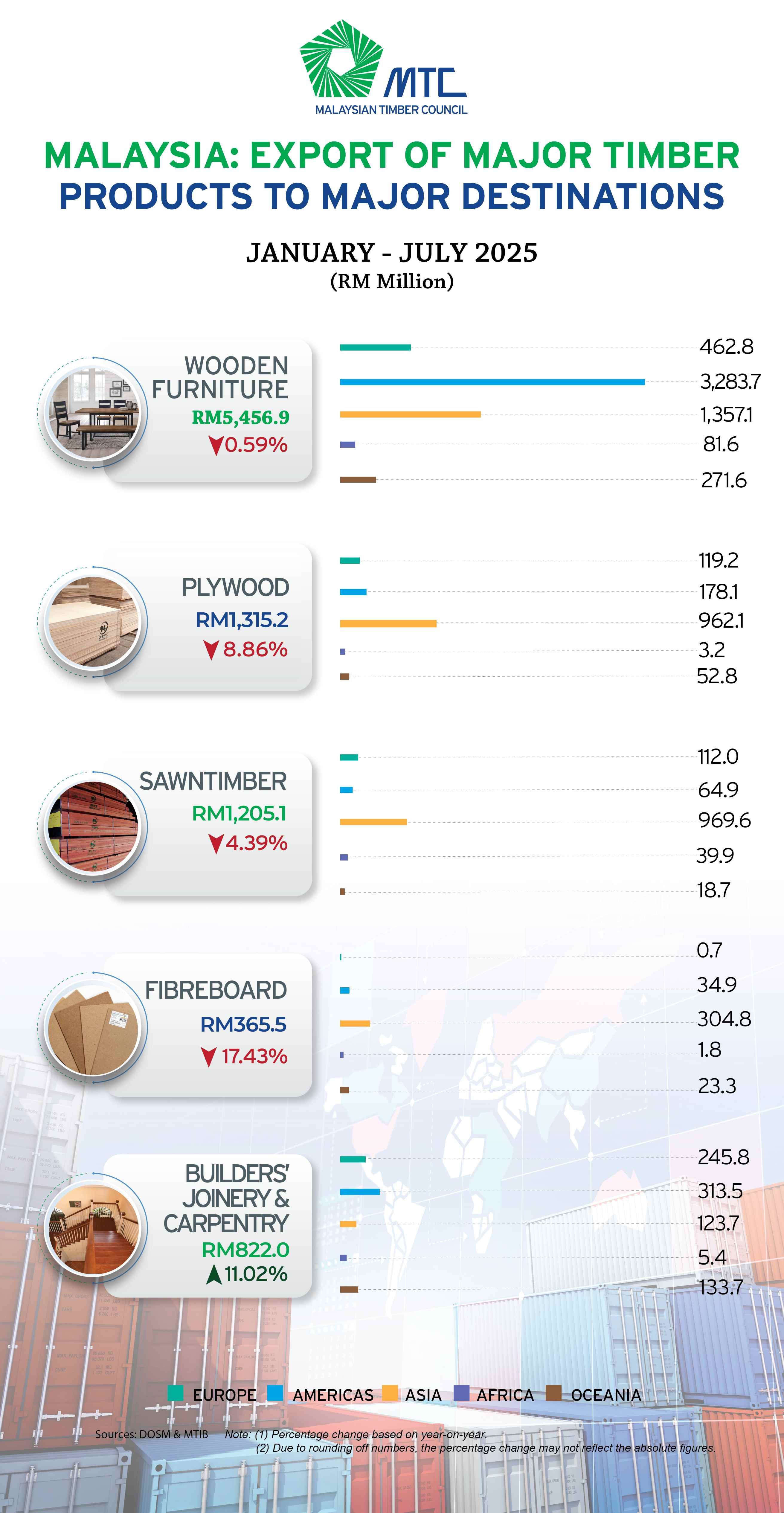
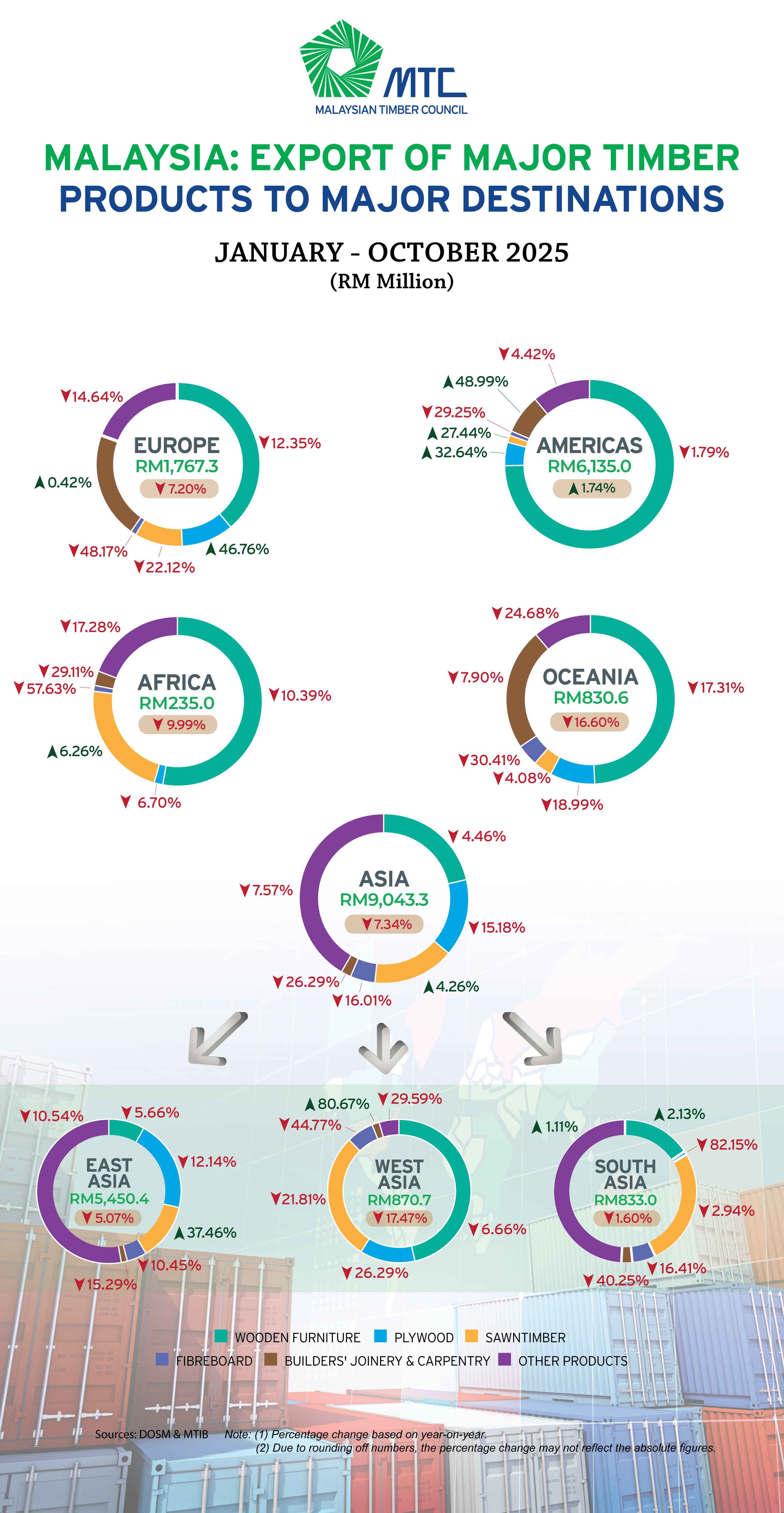
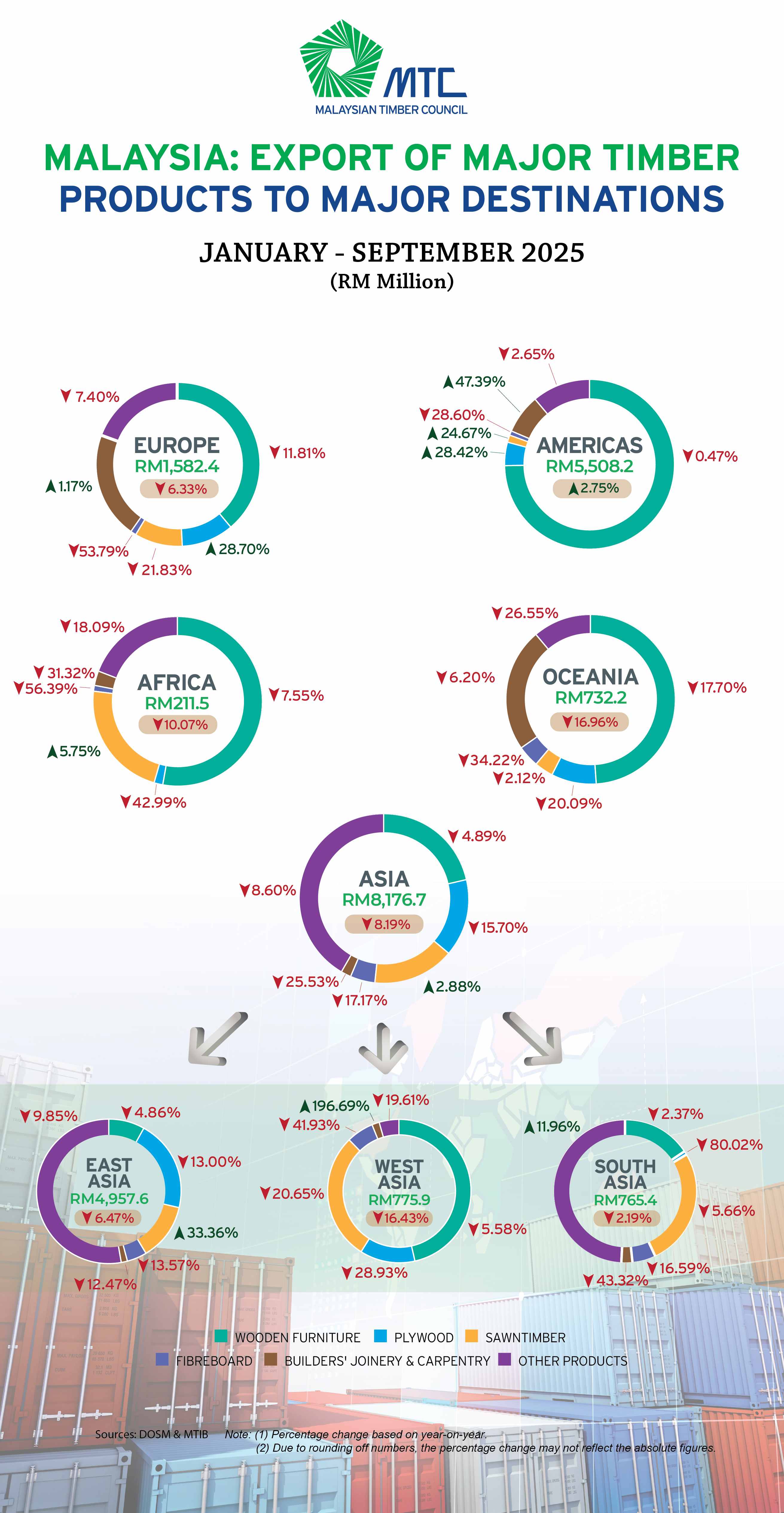
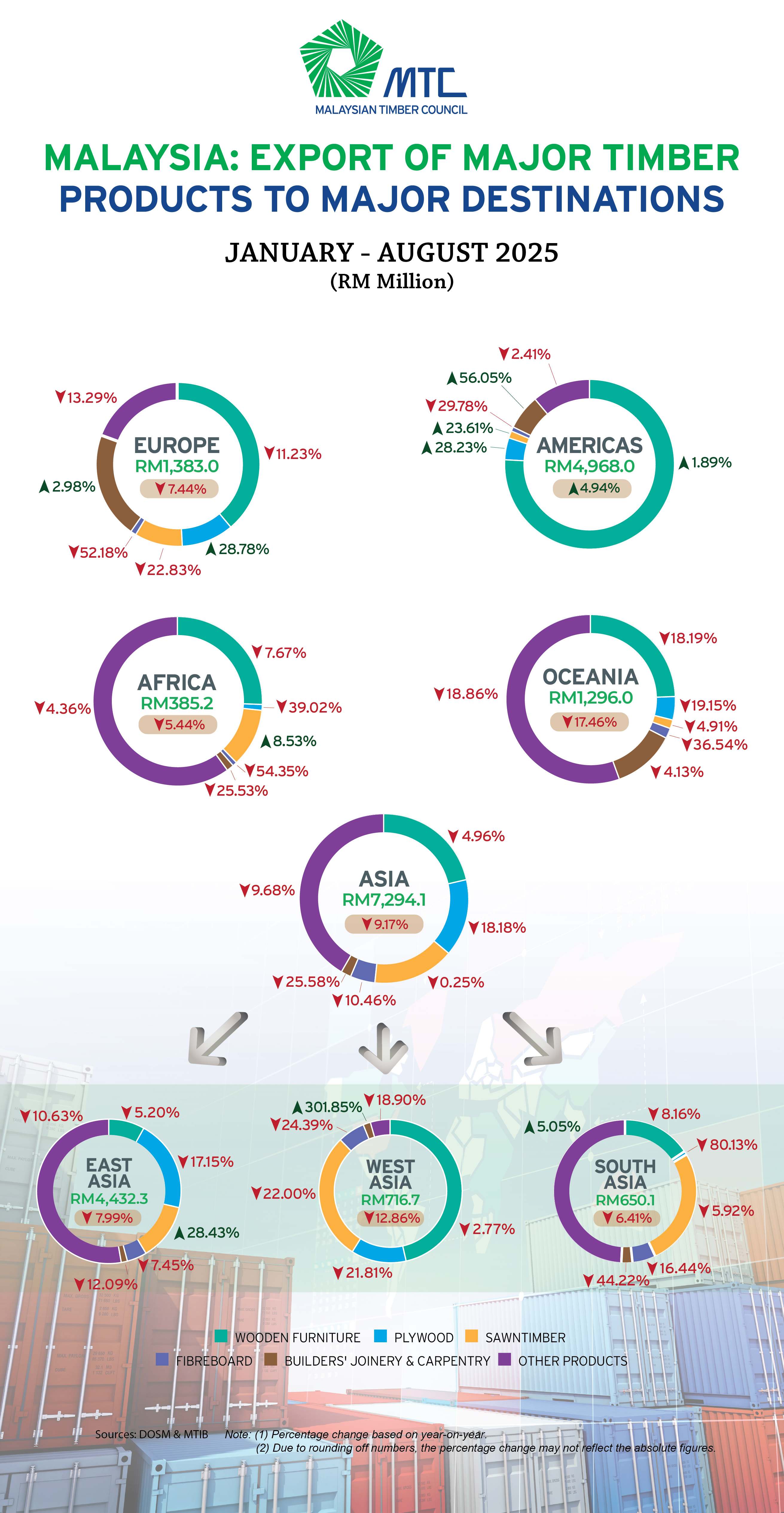
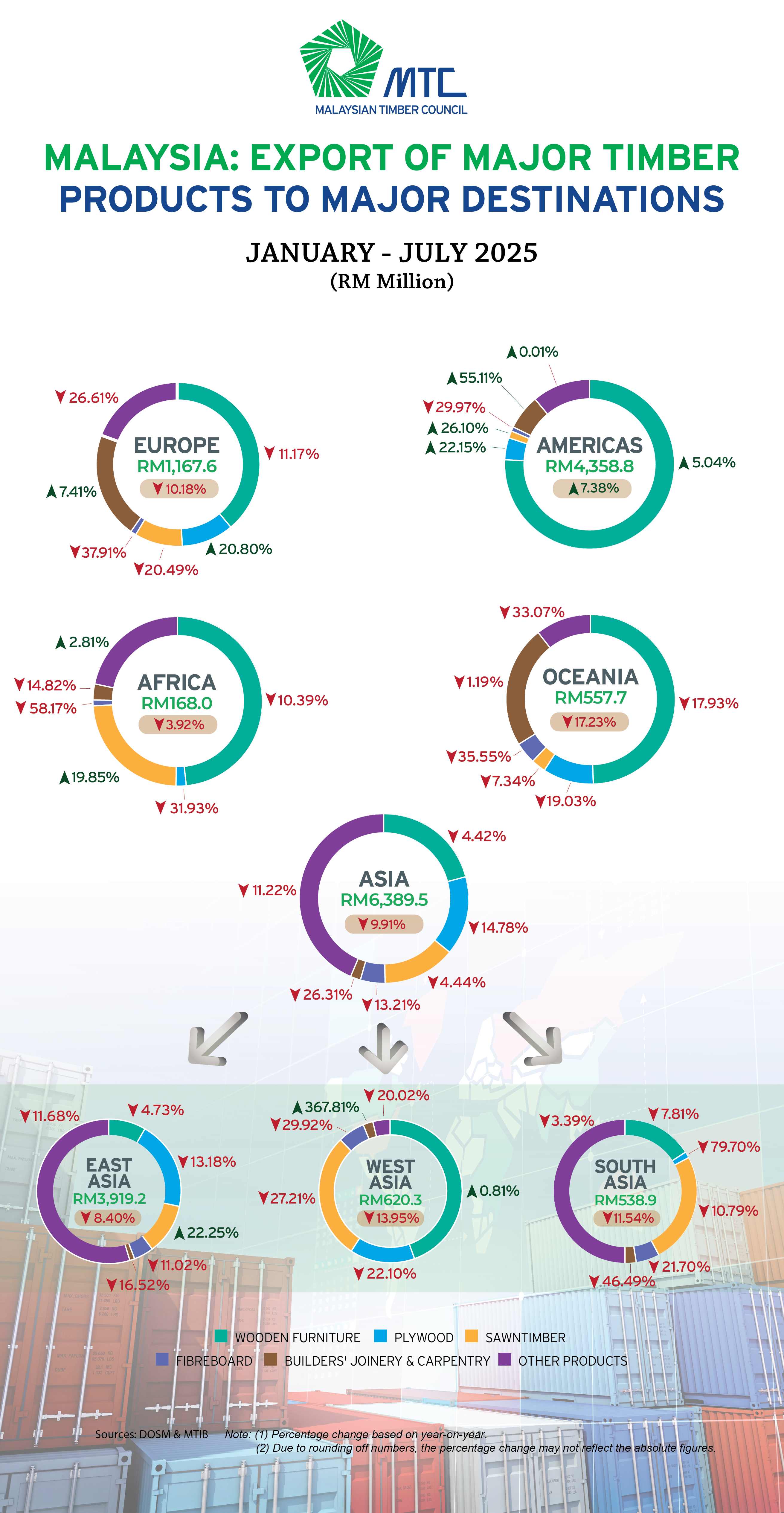
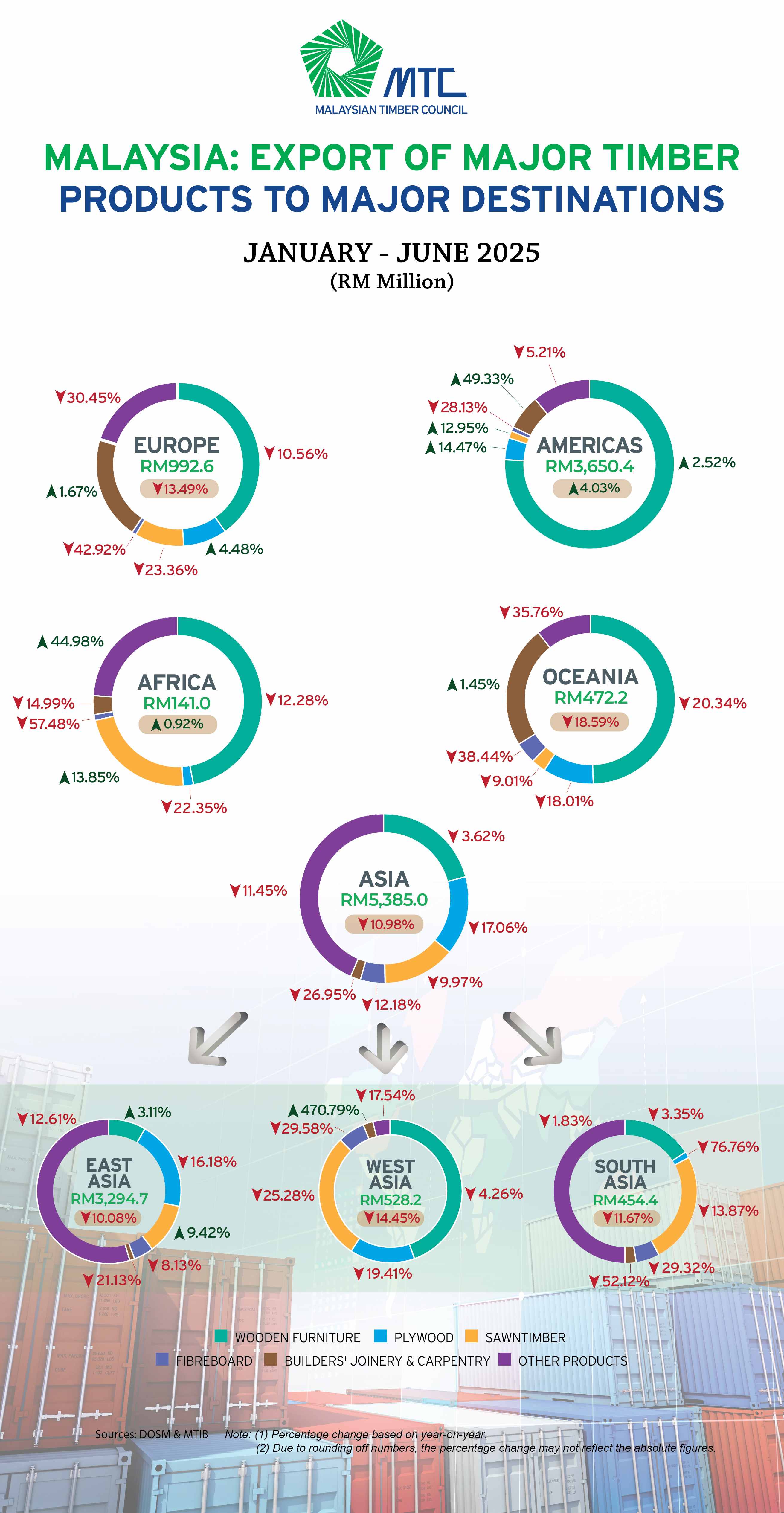
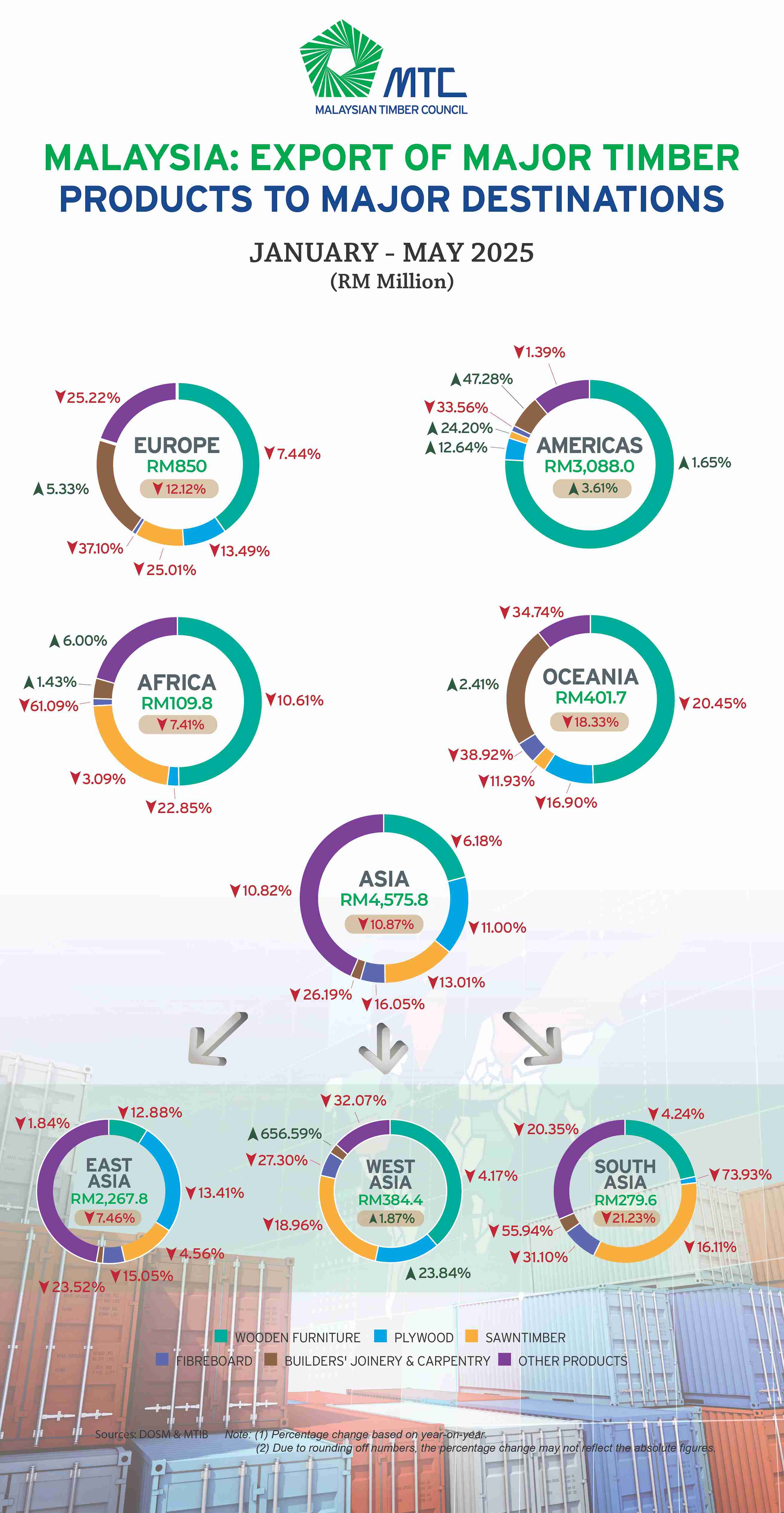
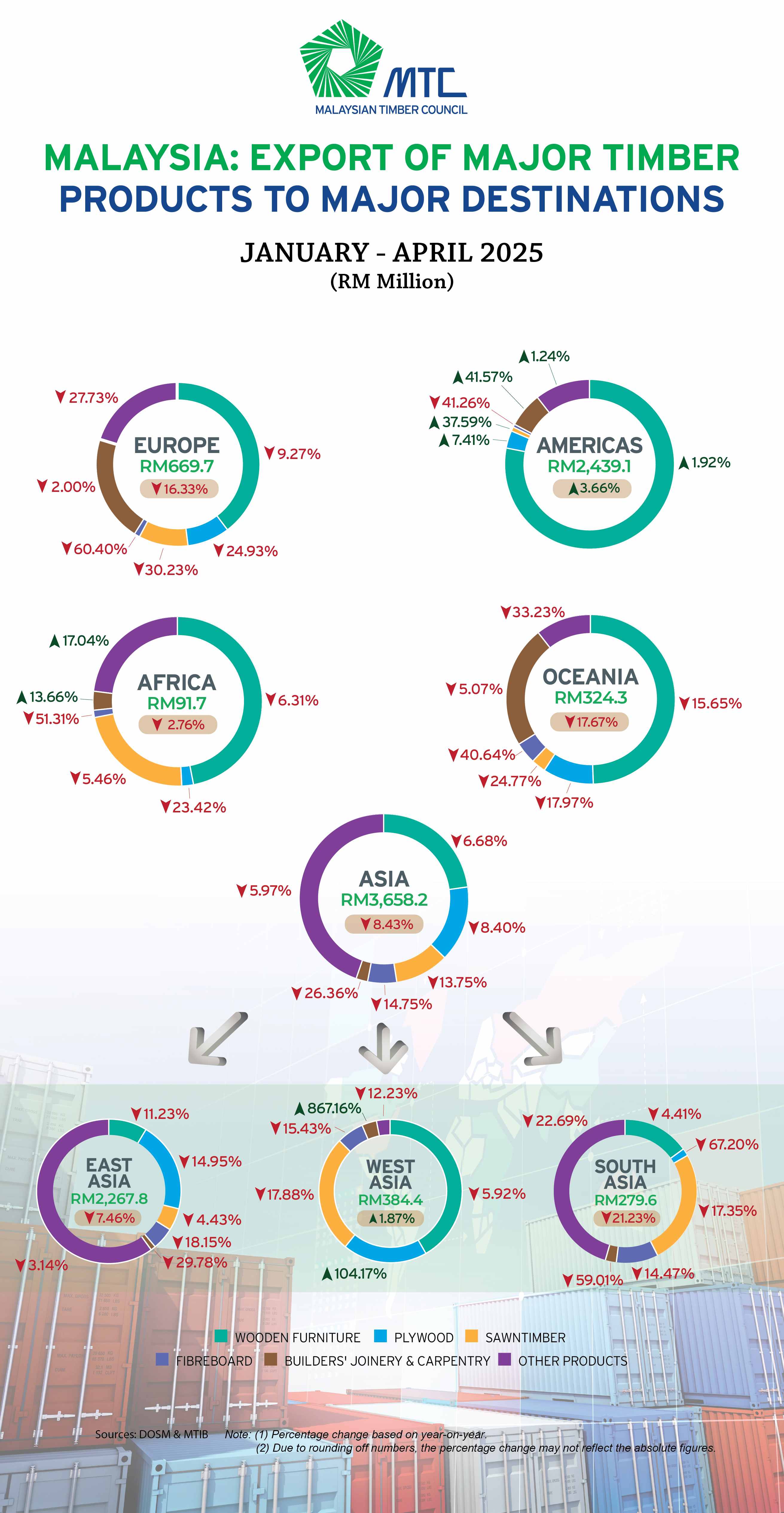
2025 Performance of the Malaysian Timber Trade

(Sources : DOSM and MTIB)

Timber Export Statistics

2024 Performance of the Malaysian Timber Trade

(Sources : DOSM and MTIB)

Timber Export Statistics

2023 Performance of the Malaysian Timber Trade

(Sources : DOSM and MTIB)

Timber Export Statistics

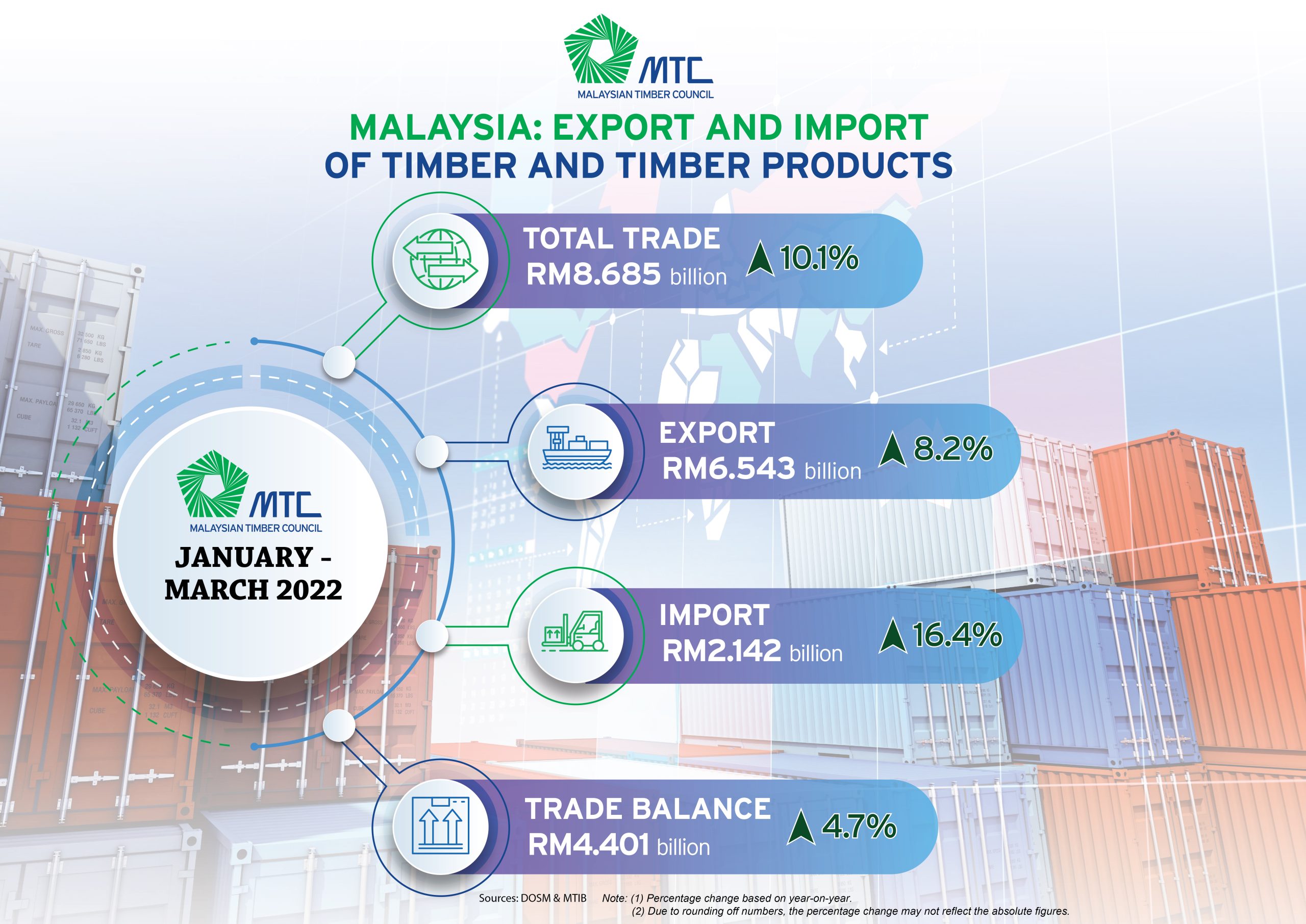
2022 Performance of the Malaysian Timber Trade

(Sources : DOSM and MTIB)

Timber Export Statistics

2021 Performance of the Malaysian Timber Trade

(Sources : DOSM and MTIB)

Timber Export Statistics

2020 Performance of the Malaysian Timber Trade

(Sources : DOSM and MTIB)

Timber Export Statistics

2019 Performance of the Malaysian Timber Trade

(Sources : MTIB)


Timber Export Statistics

2018 Performance of the Malaysian Timber Trade

(Sources : MTIB)

Timber Export Statistics

2017 Performance of the Malaysian Timber Trade

(Sources : MTIB)

Timber Export Statistics

2016 Performance of the Malaysian Timber Trade

(Sources : MTIB)

Timber Export Statistics

2015 Performance of the Malaysian Timber Trade

(Sources : MTIB)

Malaysia: Export of Major Timber Products, Jan – Dec 2015

Malaysia: Export of Timber Products by Region, Jan – Dec 2015

Malaysia: Export of Swan Timber by Destinations, Jan – Dec 2015

Malaysia: Export of Veneer by Destinations, Jan – Dec 2015

Malaysia: Export of Fibreboard by Destinations, Jan – Dec 2015

Malaysia: Export of Wooden Furniture by Destinations, Jan – Dec 2015

Malaysia: Export of Major Timber Products, Jan – Dec 2015

Malaysia: Export of Timber Products by Destinations, Jan – Dec 2015

Malaysia: Export of Plywood by Destinations, Jan – Dec 2015

Malaysia: Export of Mouldings by Destinations, Jan – Dec 2015

Malaysia:Export of BJC by Destinations, Jan – Dec 2015

Malaysia:Export of Chipboard/Particleboard by Destinations, Jan – Dec 2015

Timber Export Statistics

2014 Performance of the Malaysian Timber Trade

(Sources : MTIB)


Timber Export Statistics

2013 Performance of the Malaysian Timber Trade

(Sources : MTIB)

Global economic recovery remained fragile in 2013, despite improved prospects in some advanced economies. Some emerging economies were unfortunately saddled with geopolitical risks and lower-than-expected inflation, resulting in demand and supply constraints, infrastructure bottlenecks as well as weak investment climates that impacted international business and trade.

Despite such external environment, Malaysia’s total trade reached RM1.37 trillion in 2013, an increase of 4.6 per cent, boosted by strong demand from Southeast Asia as well as Free Trade Agreement (FTA) partner countries such as Australia, China, New Zealand and South Korea (cf. 2012: RM1.31 trillion). Malaysia’s total imports increased by 7.0 per cent to RM649.19 billion and its exports grew by 2.4 per cent to RM719.82 billion, resulting in a trade surplus of RM70.63 billion. Singapore, China and Japan were the top three export markets contributing RM100.44 billion, RM96.97 billion and RM79.75 billion respectively to Malaysia’s total exports in 2013.

While the overall performance of Malaysia’s exports ended on a positive note in 2013, this was unfortunately not the case for Malaysia’s timber exports. The export of Malaysian timber and timber products declined 3.3 per cent to RM19.53 billion, mainly due to slow and volatile global economic growth which has taken a toll on the export of Malaysia’s timber products.

Asia was by far the largest regional market for Malaysia’s timber exports accounting for 66.3 per cent of the total timber exports in 2013. However, the exports to Asia as a whole dropped by 0.8 per cent to RM12.95 billion despite Asia’s buoyant credit growths, growing middle-class consumers and strong labour markets. Meanwhile, positive growth was recorded in exports to some Asian sub-regions, i.e., Central Asia (17.2 per cent), South Asia (2.0 per cent) and East Asia (0.7 per cent). The exports to the Americas shrunk by 7.8 per cent to RM2.89 billion while Europe slumped by 13.7 per cent to RM2.01 billion. The exports to the Americas and Europe were weakened by their slow economic recovery and protracted financial crisis. The two regions accounted for 14.8 per cent and 10.3 per cent of Malaysia’s total timber exports in 2013 respectively. However, exports to South America registered a growth of 11.7 per cent. Malaysia’s export to the African continent also recorded a growth of 1.9 per cent.

By country, Japan, USA and India were the top three major export markets for Malaysia’s timber products since 2008, with a market share of 21.4 per cent, 11.8 per cent and 7.8 per cent respectively. Exports to Japan, however, declined by 2.0 per cent to RM4.18 billion (cf. 2012: RM4.27 billion). This could be attributed to the Abenomics, the Japanese economic policies advocated by Shinzō Abe since December 2012, which translated into strong but not enough domestic private demand for the Japanese economic recovery to be sustained. In addition, the devaluation of Japanese Yen in 2013 had made Malaysian exports expensive. Exports to the US dropped by 7.0 per cent to RM2.31 billion (cf. 2012: RM2.48 billion) due to its economy expanded at a weaker pace in the first half of 2013 hobbled by excessive fiscal consolidation. Exports to India, on the other hand, chalked a growth of 3.7 per cent to RM1.53 billion (cf. 2012: RM1.47 billion) as the market picked up mainly due to stronger structural policies supporting investment and trade.

Logs


Logs contributed 9.6 per cent to Malaysia’s total timber exports in 2013. The export of logs rose by 10.5 per cent to RM1.87 billion and 4.9 per cent to 3,159,902 m3 in volume terms. By region, Asia was the single largest export market for Malaysian logs, accounting for almost 100 per cent of the total log exports in 2013.

Country-wise, India was the largest market, accounting for 59.8 per cent of the Malaysia’s log export receipts in 2013. Exports to India increased by 6.4 per cent to RM1.12 billion but dipped 2.1 per cent to 1,788,275 m3 in terms of volume, partly due to the depreciation of Indian Rupee that weakened the purchasing of logs in India since June 2013. However, Malaysian logs remained competitive in the Indian market, with a market share of 27.3 per cent, trailing behind Myanmar (37.8 per cent). Malaysian exporters have been enjoying zero import tariff for logs to India under the Malaysia-India Comprehensive Economic Co-operation Agreement (MICECA) effective 1 January 2013.

Taiwan and China were Malaysia’s second and third largest markets in 2013, contributing 12.1 per cent and 10.8 per cent respectively. Taiwan’s uptake of logs from Malaysia amounted to RM225.5 million, an increase of 19.4 per cent, and its volume reached 372,054 m3, an increase of 10.0 per cent. This was mainly owing to the increased demand for consumption in sawntimber and veneer production in the Taiwanese market. Log exports to China also grew by 4.8 per cent to RM202.6 million and 6.2 per cent to 372,224 m3 in volume terms respectively. This could be due to the high demand for Merbau and Kapur logs in the Chinese market as well as the difficulties faced by the Chinese importers in importing logs from Papua New Guinea, who have resorted to source more logs from Malaysia.
Sawntimber


Malaysia’s export of sawntimber in 2013 contracted by 1.7 per cent to RM2.41 billion and 7.7 per cent to 1,898,696 m3 respectively. Sawntimber was the third largest export item, contributing 12.4 per cent to Malaysia’s overall timber exports in 2013.

By region, Southeast Asia was the biggest market for Malaysian sawntimber, accounting for 28.9 per cent of the total sawntimber exports in 2013. However, exports to Southeast Asian countries dropped by 7.9 per cent to RM696.9 million and its volume fell 14.6 per cent to 839,970 m3. Other major regional markets that imported Malaysian sawntimber were East Asia and West Asia with exports valued at RM570.9 million and RM445.1 million respectively.

Malaysia’s export of sawntimber to Europe decreased by 7.7 per cent to RM355.0 million and volume dropped by 2.9 per cent to 143,577 m3. The decrease could be attributed to the uncertainty amongst importers about the European Union Timber Regulation (EUTR) which came into force in March 2013 and economic jitters in the European markets, apart from the declining market shares by tropical hardwoods versus temperate hardwoods that had been witnessed in recent years.

Thailand was Malaysia’s largest importer of sawntimber, accounting for 18.6 per cent of the total sawntimber exports in 2013, followed by China (10.4 per cent) and Japan (5.9 per cent). However, Thailand’s sawntimber imports dipped 14.5 per cent to RM449.6 million and decreased by 27.1 per cent to 461,249 m3 in terms of volume. In fact, Thailand’s overall import of sawntimber worldwide has dropped considerably by 66.7 per cent to 3,563,030 m3 in 2013 (cf. 2012: 10,712,412 m3). This amongst others could be due to the depreciation of Thai Baht against the US Dollar that hit its lowest level since 2006 arising from the prolonged political unrest in the country. As one of Malaysia’s neighbouring countries, Thailand often adopted the “wait-and-see” approach owing to the supply volatility of Malaysian Keruing, Kempas and Yellow Meranti.

In contrast, China’s uptake of sawntimber from Malaysia was on an upward trend with a hike of 30.1 per cent year-on-year to RM249.9 million and 26.8 per cent to 186,365 m3 in terms of volume. The Chinese economy rebounded strongly in the second half of 2013 due to investment acceleration. The continuous shrinking supply of African and North American sawntimber has created an opportunity for Malaysia to increase its market share in the Chinese market especially for Keruing sawntimber.

Malaysia’s export of sawntimber to Japan fell 19.5 per cent to RM143.3 million and 25.4 per cent to 78,408 m3 in volume terms, partly led by the hesitation amongst the Japanese importers on the stimulus and reconstruction spending unwind and consumption tax hikes that would be implemented in 2014. Increased demand in the European and North American sawntimber was more noticeable, mainly due to their stable pricings towards the second half of 2013.

Plywood


Plywood was the second largest export item amongst Malaysia’s timber and timber products, contributing 27.2 per cent to the overall timber exports in 2013. Although plywood exports increased by 3.6 per cent to RM5.32 billion, it has declined slightly in volume by 0.2 per cent to 3,398,082 m3.

By region, East Asia was the largest market accounting for 69.4 per cent of Malaysia’s total plywood exports. The export reached RM3.69 billion, an increase of 2.0 per cent, but the volume declined by 1.6 per cent to 2,371,625 m3. Southeast Asia and the Americas contributed 7.9 per cent and 6.4 per cent to the total exports, valued at RM419.1 million and RM339.5 million respectively.

Japan was the single largest market for Malaysian plywood, accounting for 49.2 per cent of the total plywood exports in 2013. Japan’s import of plywood increased by 3.0 per cent to RM2.62 billion, with a volume of 1,623,076 m3, a 0.9 per cent increase. This was mainly attributed to the Japanese new construction starts which improved by 11.0 per cent to 980,025 units in 2013 (cf. 2012: 882,797 units).

South Korea and Taiwan were the second and third largest importers of Malaysian plywood, with imports valued at RM471.5 million (340,914 m3) and RM445.2 million (310,902 m3) respectively. Exports to South Korea fell 4.8 per cent and 6.6 per cent in both value and volume terms respectively, following the prolonged slump in the South Korean housing and real estate markets since 2008. The country’s housing starts decreased by 3.4 per cent year-on-year to 83,744 units in 2013. In addition, Malaysian plywood faced stiff competition from Finnish plywood that was gaining popularity in the South Korean market over the past three years, with export increased from 110,652 m3 in 2011 to 1,212,926 m3 in 2013. Exports to Taiwan increased by 8.8 per cent but decreased by 4.9 per cent in volume terms. Malaysia was the largest plywood supplier in Taiwan but volume-wise China has overtaken Malaysia to become the biggest plywood supplier in 2013.

Veneer


In 2013, Malaysia’s export of veneer accounted for 1.5 per cent of Malaysia’s overall timber exports. However, veneer exports showed a 13.8 per cent drop in value (RM287.2 million) as well as a fall of 17.6 per cent in volume (220,551 m3).

East Asia was the largest export market for Malaysian veneer, accounting for 91.7 per cent of total veneer exports. The export of veneer to East Asia however shrunk by 9.4 per cent to RM263.5 million and 12.2 per cent to 208,183 m3 in volume terms respectively.

Taiwan, South Korea and Japan were the top three major markets for Malaysian veneer. However, exports to Taiwan showed a declining trend, registering a drop of 1.6 per cent to RM146.0 million in value terms and 9.1 per cent to 113,364 m3 in volume terms. Malaysia was the largest veneer supplier in Taiwan with a market share of 52.1 per cent, followed by China (20.9 per cent) and Vietnam (8.7 per cent), New Zealand (7.4 per cent) and others (10.9 per cent). 

Malaysia’s export of veneer to South Korea also declined by 13.6 per cent to RM76.5 million and 10.1 per cent to 66,361 m3 in volume terms respectively. China has dominated the South Korean market with its high value decorative veneer that posed a stiff challenge to Malaysia. The Japanese market, on the other hand, was dominated by Russian veneer with a market share of 52.0 per cent, followed by China (29.3 per cent), Malaysia (5.3 per cent) and other smaller suppliers (13.4 per cent). Japan’s import of Malaysian veneer slipped by 25.4 per cent to RM26.1 million, with a volume of 12,996 m3, a drop of 21.7 per cent.

Medium Density Fibreboard (MDF)


MDF was the fifth largest export item, contributing 5.3 per cent to Malaysia’s overall timber exports in 2013. However, the MDF export value and volume dropped by 10.6 per cent (RM1.03 billion) and 7.6 per cent (1,045,531 m3) respectively.

By region, West Asia imported RM401.1 million worth of Malaysian MDF, accounting for 39.0 per cent of the total MDF exports. However, this represented a decline of 16.1 per cent in value terms and 18.7 per cent in volume terms (472,593 m3).

Japan has been a traditional market for Malaysian MDF accounting for 24.1 per cent of Malaysia’s total MDF exports in 2013. Japan’s MDF imports rose by 2.3 per cent to 165,710 m3. The positive uptake was due to the increase in bulk purchasing for domestic consumption that was stimulated by the Japanese’s Abenomics economic policies since December 2012. However, in value terms the export dropped by 10.0 per cent to RM247.2 million mainly due to the shift to basic grades and thicker panels of MDF offered by Malaysian exporters and the substantial devaluation of Japanese Yen against the US Dollar in 2013. The United 

Arab Emirates (UAE) was the second largest market after Japan for Malaysian MDF. The exports fell 10.4 per cent and 38.4 per cent to RM113.4 million and 139,940 m3 respectively. The decline was mainly due to the abundant supplies of low-priced Chinese, Indonesian and Thai MDF in the UAE market.
On the contrary, Saudi Arabia’s uptake of Malaysian MDF registered a positive growth of 36.4 per cent to RM93.1 million, making Saudi Arabia the third largest market. The export volume reached 105,596 m3, representing a positive increase of 68.4 per cent, buoyed by the strong government stimulus and rapid credit growth. With a growing population of 29.2 million, Saudi Arabia has been facing affordable housing shortage which US$65 billion was earmarked in 2013 by the King of Saudi Arabia, His Majesty King Abdullah, for construction of 500,000 low-cost housing units across the Kingdom. Melamine MDF, veneer MDF and plain MDF of various sizes were largely consumed by local factories producing furniture, kitchen cabinets, wardrobes, drawers, doors and other interior applications.
Mouldings


Mouldings contributed 3.2 per cent to Malaysia’s total timber export earnings in 2013. The exports declined by 13.0 per cent and 15.3 per cent to RM619.1 million and 225,336 m3 respectively.

Amongst the regions, Europe was the biggest market contributing 42.4 per cent of the total export of mouldings in 2013. However, the exports to this region dwindled by 14.7 per cent to RM262.8 million and 21.9 per cent to 82,828 m3. This was followed by East Asia and the Oceania/Pacific regions which contributed 22.0 per cent and 17.2 per cent respectively to the total export receipts. Similar to Europe, exports to East Asia decreased by 13.1 per cent to RM136.4 million and 15.5 per cent to 56,510 m3. Exports to Oceania/Pacific region however showed an upward trend, registering a hike of 4.7 per cent in value to RM106.3 million and 5.3 per cent in volume to 37,785 m3.

Despite its weak economy, The Netherlands retained its position as the largest importer of Malaysian mouldings, accounting for 18.2 per cent of the total mouldings exports in 2013. The export marginally increased by 0.8 per cent to RM112.5 million. However, the export volume dropped by 9.4 per cent to 34,694 m3. The Dutch economy had been shrinking since the second quarter of 2012, weighed down by a persistent slump in the housing market that hit highly indebted households.

Australia and Japan contributed 17.1 per cent and 14.0 per cent to the total mouldings exports in 2013, making them the second and third largest markets respectively. Shipments to Australia increased by 5.4 per cent to RM105.7 million and 5.9 per cent to 37,522 m3. However, China has increased its market share and overtook Malaysia to be the third largest mouldings supplier in Australia, after Indonesia and New Zealand. Malaysia’s export of mouldings to Japan dropped by 13.7 per cent to RM86.8 million and 19.5 per cent to 29,187 m3. Demand for Vietnamese mouldings in the Japanese market has increased and the country has overtaken Malaysia to become the third largest mouldings supplier, after China and Indonesia.

Buiders’ Carpentry And Joinery (BCJ)


In 2013, Malaysia’s export of Builders’ Carpentry and Joinery (BCJ) decreased by 4.4 per cent to RM949.6 million. It contributed 4.8 per cent of Malaysia’s total timber exports in 2013.

By region, Europe was the largest market for Malaysian BCJ, accounting for 30.7 per cent. Malaysia’s export of BCJ to Europe fell 2.1 per cent to RM291.9 million. Southeast Asia was the second largest regional market, accounting for 21.1 per cent, with export of RM200.1 million, an increase of 6.6 per cent year-on-year.

Country-wise, Australia was the leading importer of Malaysian BCJ in 2013, followed by Singapore and the United Kingdom. Exports to Australia rose by 7.0 per cent to RM124.3 million, even though the construction sector was hardly triggered by the increasing housing building approvals, given the lack of full-time workers, which caused the increase of housing prices throughout 2013. The Australian housing building approvals in 2013 increased to 172,560 units, an increase of 17.7 per cent (cf. 2012: 146,612 units). Australian retailers reported that Malaysian BCJ, especially flooring, was of good quality, well priced and in a good range of sizes and species.

Singapore, as a re-export hub, imported RM115.2 million worth of Malaysian BCJ in 2013, a year-on-year increase of 3.2 per cent. Being Singapore’s closest neighbour, Malaysia continued to be the single largest supplier of BCJ to Singapore, with a market share of 47.2 per cent, followed by China (26.3 per cent), Indonesia (9.0 per cent), Vietnam (8.4 per cent) and others (9.1 per cent). Improvement was also seen in Malaysia’s export of BCJ to the United Kingdom, with export of RM114.5 million, an increase of 12.4 per cent. Since the first quarter of 2013, construction activities had picked up considerably in the United Kingdom; initially, this was due to a rapid rise in house buildings; later, growth in new infrastructure and a recovery in London’s commercial activities had built upon further rises in private housing.

Wooden Furniture


Malaysia remained as the world’s eighth largest furniture exporter for three consecutive years, with export valued at RM7.36 billion in 2013. However, the furniture exports dropped by 8.0 per cent year-on-year.

Of the furniture exported by Malaysia, wooden furniture was the biggest export item with a share of 78.9 per cent, followed by seats and their parts (9.3 per cent), metal furniture (7.5 per cent), parts of furniture (3.7 per cent), plastics furniture (0.3 per cent) and others (0.3 per cent). In 2013, Malaysia’s export of wooden furniture reached RM5.74 billion, a decrease of 12.1 per cent year-on-year.

The US was the single largest market for Malaysian wooden furniture, accounting for 31.5 per cent of Malaysia’s total wooden furniture exports in 2013. However, Malaysia’s export of wooden furniture to the US fell 7.9 per cent to RM1.81 billion, although housing units completed in the US in 2013 stood at 764,400, a year-on-year increase of 17.7 per cent. Malaysia faced intense competition from Chinese and Vietnamese furniture exporters as well as other emerging players from India and Indonesia in the US, particularly on casegood furniture.

Japan has maintained its position as the second largest importer of Malaysian furniture, accounting for 10.0 per cent of the total wooden furniture exports. The exports reached RM571.3 million, a drop of 17.6 per cent. The Japanese market was largely dominated by Chinese furniture with a market share of 60.9 per cent. Apart from China, Malaysia was outperformed by Vietnam, Taiwan, Thailand and Indonesia in supplying furniture to Japan in 2013. Malaysia’s export of wooden furniture to Australia, the third largest furniture market, marginally dropped by 0.7 per cent, valued at RM424.9 million. Chinese furniture has also dominated the Australian market with a market share of 62.9 per cent.

In West Asia, the UAE was the single largest market for Malaysian furniture, with export valued at RM206.6 million, accounting for 3.6 per cent of the total wooden furniture exports. Malaysian furniture was seen as “value for money” with competitive pricing and quality finishing in the Middle East.

2014 Outlook


Export of Malaysia’s timber and timber products, including furniture, is expected to see improvement above the 2013 levels as global economic growth is anticipated to rebound in 2014 supported by monetary policies amid improving financial conditions in the affected countries.

A major impulse to global economic growth is expected to emerge from the US, whose economy grew at a faster-than-anticipated pace in the second half of 2013. This was led by its buoyant domestic demand, robust inventory accumulation and strong export growth. More optimisms are expected to derive from the US Federal Reserve’s monetary stimulus, easier bank lending conditions and higher household wealth. A recovering real estate sector is also expected to translate into a greater demand in construction materials and household products, including furniture.

With the exception of the United Kingdom, Germany and France, the growth in the rest of the Euro area is expected to remain weak as high debt and financial fragmentation hold back domestic demand. However, the European Commission expects the job market to improve; forecasting unemployment would fall to 10.1 per cent in 2014. Market confidence in the United Kingdom hardwood sector is expected to grow, led by new house-building revival plan, attributable to the government’s “Help to Buy” mortgage support scheme. The German construction activity has been on the rise since the second quarter of 2013 and is expected to remain optimistic in 2014 which might lead to improved export of timber and timber products from Malaysia.

In Japan, some growth drivers are expected to strengthen, notably private investment and exports, given increased growth in their partner countries and the substantial Japanese Yen depreciation throughout 2013. However, Japan’s economic activities are anticipated to slow down as industry players are doubtful about the re-construction spending unwinds and consumption tax hikes that are expected to be implemented in 2014.

Emerging markets had been roiled by capital outflows in 2013 as their investors began positioning for the US Federal Reserve to start tapering its monetary stimulus. The World Bank forecast that the Chinese economic growth would remain at about 7.6 per cent in 2014, as the Chinese authorities gradually rein in rapid credit growth and make progress in implementing their reform blueprint so as to put the economy on a more balanced and sustainable growth path. India’s growth is expected to recover from 4.4 per cent in 2013 to 5.4 per cent in 2014, supported by a slightly stronger global growth, improving export competitiveness and implementation of investment projects.

The International Monetary Fund (IMF) forecast the regional growth in the Middle East and North Africa (MENA) to rise moderately in 2014, led by the oil-exporting countries, where high public spending contributes to buoyant non-oil activities. However, high unemployment, low competitiveness, and in many cases, large public deficits would continue to weigh on economic prospects in the region. In the UAE, the rise in real estate especially for the residential sector had improved market sentiments. The emirate of Dubai in UAE has been awarded to host World Expo 2020 that is expected to generate national income of US$24.2 billion, encouraging developers to launch more building construction projects that would lead to increased consumption of timber and timber products.

Among Southeast Asian economies, the biggest changes in the World Bank’s economic forecasts were for Thailand and Myanmar. The World Bank forecast Thailand’s economic growth at 3.0 per cent in 2014, mainly attributable to a recovery in external demand that would lift growth in Thailand. Domestic demand in Thailand, however, is predicted to remain dampened because of the ongoing political unrest, which has affected tourism receipts, public investment and investor confidence. Economic growth in Myanmar is likely to stabilise at 7.8 per cent in 2014, after the country made positive progress in 2013 on their macro-economic reforms. Myanmar’s ban on log exports in April 2014 might spur countries like China and India to turn to Malaysia for supply of logs and sawntimber.

Timber Export Statistics

2012 Performance of the Malaysian Timber Trade

(Sources : MTIB)

Export of Major Timber Products 2012


Protracted financial crisis in Europe continued to affect Malaysia’s total exports while the slow economic recovery in USA and Japan as well as the GDP decelerations in China and India impacted the export momentum in 2012. Amidst the challenging global economic environment, Malaysia’s total trade for 2012 reached a value of RM1.31 trillion compared with RM1.27 trillion recorded in 2011. Exports increased marginally by 0.6% to RM702.19 billion while imports grew by 5.9% to RM607.36 billion, resulting in a trade surplus of RM94.83 billion. Malaysia has had a trade surplus for fifteen consecutive years since 1997. Malaysia’s top three trading partners were Singapore, China and Japan contributing RM95.5 billion, RM88.8 billion and RM82.9 billion respectively to Malaysia’s total exports in 2012.

The Malaysian timber sector’s contribution of RM20.2 billion in 2012 was made up by exports of wooden furniture (32.3%), plywood (25.4%), sawntimber (12.2%), logs (8.4%), MDF (5.7%), BCJ (4.9%), mouldings (3.5%), particleboard (1.7%), veneer (1.6%) and other timber products (4.3%).

By region, Asia accounted for 64.6% of Malaysia’s overall timber exports in 2012, an increase of 0.5% to RM13.1 billion. Asia, being the world’s fastest growing consumer market with its rising income and a growing middle class, had propped up the global trade in 2012. Americas and Europe contributed 15.5% and 11.5% of overall timber export receipts respectively. Exports to Americas expanded by 10% (to RM3.14 billion), but Europe contracted by 6.5% (to RM2.33 billion). In 2012, Malaysia’s timber exports to North America, West Asia, Central Asia and Europe (non-EU) registered impressive year-on-year growth rates of 10.4%, 20%, 20.9% and 21.7% respectively.

Since 2008, Japan, USA and India have remained the top three major export markets for Malaysia’s timber products, accounting for 40.7% of its overall global timber trade in 2012. Japan retained its position as the single largest destination with imports amounting to RM4.3 billion or 21.1% of Malaysia’s overall timber exports. However, export receipts from Japan dropped by 7.3% compared to 2011. USA contributed 12.3% (RM2.5 billion) while India contributed 7.3% (RM1.5 billion) to Malaysia’s overall timber export receipts.

Logs


As the fourth largest export item, logs contributed 8.4% to Malaysia’s total timber export earnings in 2012. Malaysia’s export of logs fell by 13.4% to RM1.691 billion in value terms and declined by 9.2% in volume terms to 3,011,971 m3.

By region, Asia was the largest export market for Malaysian logs, accounting for 99.86% of total logs export earnings. Shipment of logs to Asian countries declined by 9.1% to 3,011,112 m3 in volume and by 13.3% to RM1.689 billion in value in 2012.

By country, India was the largest market for Malaysian logs accounting for 62.1% of Malaysia’s log export receipts in 2012. Exports to India decreased by 7.4% to RM1.05 billion in terms of value and decreased by 2.8% to 1,826,844 m3 in terms of volume in 2012. Due to the increase in Malaysian log prices, many plywood manufacturers in India who used to import Malaysian logs had switched to Keruing logs from Myanmar. The main species imported by India were Balau, Meranti, Kapur and Keruing.

China and Taiwan emerged as Malaysia’s second and third largest markets, contributing 11.4% and 11.2% respectively. China’s importation of logs amounted to RM193.4 million, a decrease of 7.6% and its volume fell by 10.2% to 350,615 m3 in 2012. This was mainly due to the usage of softwoods by China’s plywood mills as the price is cheaper compared to tropical logs. Taiwan’s uptake of logs also fell by 19.7% to RM188.9 million and volume fell by 12.6% to 338,094 m3 in 2012. Japan’s ranking slipped to fourth position, with total imports plummeting by 41.7% in value terms to RM133.7 million and by 42.5% in volume terms to 207,197 m3. The stiff competition from softwood logs imported from Russia, USA, Canada and other European countries had also contributed to the reduction in Malaysia’s log exports to China and Taiwan..

Sawntimber


Sawntimber export value and volume contracted by 1.1% (to RM2.5 billion) and 1.2% (to 2,057,625 m3) respectively. Sawntimber was the third largest export item, contributing 12.2% to Malaysia’s overall timber export receipts in 2012.

By region, Asia was the leading importer of Malaysian sawntimber, accounting for 75.1% of total sawntimber exports in 2012. Total imports by Asian countries increased by 6.2% to RM1.8 billion and 2.4% to 1,797,009 m3 in 2012. Europe’s import of sawntimber dipped significantly by 24.4% to RM384.6 million in value and 25.1% to 147,848 m3 in volume terms.

Residential construction was the largest construction category in the Dutch construction industry, with a 45.1% share of the industry’s total value in 2012. Despite this, prospects for growth in the residential construction market remained bleak, as depressed economic conditions made it difficult for Dutch households to repay housing debts. Prospective buyers, especially those looking to buy property, as well as households looking to refinance their debt, were finding it difficult to secure mortgages. There seemed to be little improvement of this situation in the short term, as the Dutch government implemented measures to protect the banking system from the risk of large mortgage defaults, largely as a result of the economic slowdown following the financial crisis and resulting austerity measures.

Thailand continued to be Malaysia’s top importer of sawntimber, accounting for 21.4% of total export revenues in 2012. The country’s uptake jumped by 13.5% to RM525.7 million although its volume decreased marginally by 0.6% to 632,755 m3 in 2012. After the floods at end-2011, Thailand’s reconstruction spurred economic activities, generating higher imports of raw materials, including sawntimber.

China and Japan were the second and third largest importers, accounting for 7.8% and 7.2% of total export respectively. However, China’s import of Malaysian sawntimber fell by 26.6% to RM192.1 million in value, and 23.2% to 147,032 m3 in volume terms. China’s growth in property sales slowed due to the Government’s policy of tightening credit and administrative curbs on home purchases to prevent a housing bubble.

In contrast, Japan recorded an increase in the import of sawntimber from Malaysia by 9.9% to RM177.9 million and volume up by 21.1% to 105,100 m3. Housing starts in Japan rose 10.3% in November 2012 from a year earlier, up for the third straight month according to the Ministry of Land, Infrastructure, Transport and Tourism, which was supported by a rush in demand before expected sales tax hikes and increased reconstruction activities in areas hit by the previous year’s earthquake and tsunami.

Plywood


Plywood raked in the second highest export earnings, contributing 25.4% to Malaysia’s overall timber exports in 2012. The plywood sector recovered from its downward trend in 2011 to positive territory in 2012 with exports increasing by 0.7% to RM5.14 billion in value and 7.4% to 3,406,086 m3 in volume terms.

By region, Asia accounted for 84.4% of Malaysia’s plywood exports with receipts reaching RM4.33 billion in 2012, an increase of 0.4% while export volume increased by 9.5% to 2,936,128 m3. Americas and Europe accounted for 6.2% and 4.2% of total plywood export receipts, valued at RM317.7 million and RM217.6 million respectively.

Country-wise, Japan remained the largest buyer of Malaysian plywood, accounting for 49.5% in value terms of overall plywood exports in 2012. Japan’s purchase of plywood from Malaysia was up by 7.5% to 1,608,922 m3, valued at RM2.542 billion, but this was a decrease of 6% in value terms year-on-year. Increase in the volume of plywood exported was mainly attributed to Japan’s post-tsunami and earthquake reconstruction.

South Korea overtook Taiwan to emerge as the second largest buyer of plywood from Malaysia in 2012. Plywood export volume to South Korea increased by 10.1% to 365,167 m3 while export value surged by 14.9% to RM495.3 million. Expansion of both the South Korean infrastructure and residential construction sectors contributed to the higher demand for Malaysian plywood.

In comparison, Taiwan slipped to third position with total plywood imports from Malaysia valued at RM409.3 million, a decline of 6.8%, while volume dropped by 3.7% to 327,069 m3. South Korea and Taiwan accounted for 9.6% and 8% respectively of Malaysia’s total plywood exports in 2012.

Veneer


In 2012, the export value of veneer by Malaysia increased by 2.7% to 267,561 m3 while export earnings increased by 3.7% to RM333.2 million year-on-year. Similar to 2011, it accounted for 1.6% of the country’s overall timber exports in 2012.

By region, Asia remained the largest market for Malaysian veneers. It absorbed 95.7% of total veneer exports in 2012. Total value and volume recorded an increase of 4.6% to RM318.8 million and 2.9% to 262,503 m3 respectively.

Taiwan, South Korea and Japan remained as the top three major markets for Malaysian veneer. Taiwan was the top importer with total imports valued at RM148.4 million, down 5.8% and import volume fell by 7.5% to 124,705 m3 in 2012.

Malaysia’s export of veneer to South Korea recorded an increase 45.8% in volume to 73,828 m3 and value by 52.4% to RM88.5 million in 2012. Japan, on the other hand, recorded negative growth in 2012. Export volume and value to Japan decreased by 12.5% and 4.2% to 16,605 m3 and RM35 million respectively.

Medium Density Fibreboard (MDF)


Medium Density Fibreboard (MDF) contributed 5.7% to Malaysia’s overall timber exports in 2012. MDF export volume and value increased by 1.9% and 1.8% to 1,132,096 m3 and RM1.15 billion respectively. It was the fifth largest contributor to Malaysia’s overall timber exports in 2012.

By region, Asia accounted for 90% of Malaysia’s export receipts for MDF in 2012. Both export value and volume for MDF increased by 2.1% to RM1 billion and by 2.7% to 1,053,897 m3.

Japan continued to be Malaysia’s top importer, accounting for 23.9% of total MDF exports in 2012. The country purchased RM274.7 million worth of MDF, an increase of 7.3% and total volume increased by 6.4% to 161,964 m3 in 2012. Since the tsunami in March 2011.

Malaysian MDF manufacturers had been shipping a huge portion of their production to Japan for the reconstruction of areas devastated by the earthquake and tsunami.

Iran and UAE were close contenders with 12.9% and 11% of total MDF export receipts respectively. Total volume shipped to Iran rebounded by 22.6% to 156,040 m3, valued at RM148.8 million, an increase of 28.3% as compared to 2011. Iran has remained the second largest buyer of Malaysian MDF since 2010. The traditional MDF suppliers from Europe had ceased to do business with Iran due to the economic sanctions imposed on the latter, leaving a huge supply deficit. The shortfall in MDF supply to Iran was largely taken up by suppliers from Malaysia, China and Turkey.

For UAE, shipments increased by value and volume terms to RM126.6 million (up 13.1%) and to 227,273 m3 (up 85.8%) in 2012. Apart from ongoing public projects in Abu Dhabi, several residential and commercial projects have been revived in Dubai, fuelling demand for MDF for various interior works. In addition, showrooms, retail outlets in malls, commercial offices underwent refurbishments and renovations which also required large volumes of MDF.

Mouldings


Mouldings contributed 3.5% to Malaysia’s total timber export earnings in 2012. Export value and volume declined by 6% and 7.9% to RM711.9 million and 265,886 m3 respectively.

By region, Europe was the largest market for Malaysian mouldings, accounting for 43.3% of Malaysia’s total export of mouldings in 2012. Europe-bound mouldings export volume and value decreased by 6.3% and 6.5% to 106,021 m3 and RM308 million respectively. This was followed by Asia and the Oceania/Pacific regions which contributed 29.8% and 14.3% respectively to total export receipts. Export of mouldings to Asian countries decreased by 8.3% to 91,773 m3 in terms of volume and decreased by 7.6% to RM211.8 million in value terms. Export volume and value to the Oceania/Pacific region recorded a dip of 16.7% and 11.4% to 35,886 m3 and RM101.5 million respectively.

The Netherlands retained its position as the largest importer of Malaysian mouldings accounting for 15.7% of total mouldings exports in 2012. However, due to reduced activities in home improvement, refurbishment and DIY sectors, The Netherlands’ import of mouldings decreased by 16% to 38,313 m3, valued at RM111.6 million, down 22.7% compared to the previous year.

Japan and Germany trailed closely behind as the second and third largest markets, both accounting for 14.1% respectively. Shipments to Japan declined by 13.2% to 36,257 m3, valued at RM100.7 million, a drop of 13.2%. Meanwhile, Malaysia’s export of mouldings to Germany increased both in volume and value terms by 13.3% and 16.1% to 33,205 m3 and RM100.4 million respectively.

Buiders’ Carpentry And Joinery (BCJ)


In 2012, Malaysia’s export of Builders’ Carpentry and Joinery (BCJ) registered a marginal decline of 1.3% to RM993.1 million. It contributed 4.9% of Malaysia’s overall timber export receipts in 2012.

By region, Asia was the largest market with total imports of BCJ amounting to RM472.4 million or 47.6% of total export of BCJ, an increase of 9.7% over 2011. Europe and Oceania/Pacific regions accounted for 30% and 12.3% in 2012. Europe’s import of BCJ declined by 11% to RM298.2 million. Likewise, Oceania/Pacific’s imports fell by 5.6% to RM121.7 million.

Australia was the leading importer of Malaysian BCJ in 2012 followed by Japan and Singapore. However, exports to Australia decreased by 5.2% to RM116.2 million due to poor housing starts. Following a 11.3% fall in housing starts in 2011, there was a further decline of 2.2% in 2012, to 147,610 units as home building was hampered by higher interest rates as well as a glacial pace of reforms in the Australian housing market.
Meanwhile, export to Japan rose slightly by 2.4% to RM113.6 million in 2012. Likewise, Singapore increased its import of BCJ by 28.3% to RM111.6 million.

Wooden Furniture


Wooden furniture has been the largest export earner since 2007 for the country’s wood-based industry. In 2012, export of wooden furniture expanded by 5.3% year-on-year, contributing 32.4% or RM6.5 billion, to Malaysia’s export of total major timber products.

USA continued to be the single largest market for Malaysian wooden furniture, accounting for 30.1% of Malaysia’s total wooden furniture exports in 2012. Benefitting from early signs of recovery in the US economy represented by improved housing starts and declining unemployment figures, Malaysia’s exports to USA grew by 10.1% valued at RM1,964.8 million following a decline in exports by 14.1% in 2011.

In 2012 Japan continued to rank as the second largest importer accounting for 10.6% of Malaysia’s total export receipts for wooden furniture, although exports to Japan contracted by 10.5% to RM694 million. Meanwhile, Malaysian wooden furniture exports to Australia, the third largest export destination, rose slightly by 2.3% to RM427.8 million. United Kingdom’s furniture import increased by 6.2% to RM377.6 million. Singapore, the fifth largest buyer of Malaysian wooden furniture since 2011, increased its import by 3.2% to RM338.9 million in 2012.

2013 Outlook


Malaysia’s timber export is expected to see growth above the 2012 levels in tandem with the solid growth momentum in Asia, despite the anemic growth of the US and the troubled European economies. It is hoped that Asia’s continued growth, albeit at a slower pace, would translate into greater global demand for timber-based products, particularly valued-added items.

The Eurozone may remain mired in recession, bogged down by the PIGS’ (Portugal, Italy, Greece and Spain) sovereign debt and unemployment crises. Asian economies, led by China, have, in the last few years, shifted towards internal growth, particularly with rising income levels and generally young population feeding domestic investment and consumption. China would continue to be the largest economy in Asia and the biggest trading partner for most Asian economies, including Malaysia.

Economists forecast growth could be even stronger in Asia in 2013, which has clearly outperformed other regions. On a more regional level, to circumvent international economic and financial uncertainties, ASEAN member states would undertake initiatives to forge closer collaboration in trade and investment within the region. These initiatives are expected to enhance intra-regional trade towards ASEAN Economic Community by 2015. Closer economic linkages with emerging economies in the region would help Malaysia and other participating countries diversity their markets and reduce over-reliance on the advanced economies.

Although global growth is expected to increase in 2013, the World Bank contends that general economic recovery in a few major regions will remain fragile. Growth in high income countries would be weak and the export-dependent regions face risks from Europe’s still unresolved sovereign debt crisis. According to World Trade Organisation, world trade growth fell to 2% in 2012 down from 5.2% in 2011 and is expected to remain sluggish in 2013 at around 3.3% as the economic slowdown in Europe continues to suppress global growth.

Timber Export Statistics

2011 Performance of the Malaysian Timber Trade

(Sources : MTIB)

Export of Major Timber Products 2012


2011 started out robustly amidst signs of global recovery with the US economy recording a 3% growth in the last quarter of 2010. However, global outlook began to deteriorate with the rise of civil unrest in North Africa and the Middle East region, which resulted in rising fuel prices. The devastating earthquake, tsunami and nuclear incident in Japan as well as massive floods in Thailand further disrupted the supply chain causing major concerns for much of the year.

The worsening Eurozone debt situation that spread to larger member states, such as Spain and Italy in the final quarter of 2011 did little to improve global market confidence. Despite the challenging global environment in 2011, Malaysia has remained resilient due to diversification of the country’s trade exposure to developing and emerging markets such as China and India. Malaysia’s total trade in 2011 reached the highest total trade ever recorded at RM1.269 trillion, an increase of 8.7% as compared to the previous year.

In 2011, China surpassed Singapore to emerge as Malaysia’s largest export market, contributing RM91.25 billion or 13.1% of her total export, whilst India recorded an encouraging 34.6% growth from RM20.93 billion in 2010 to RM28.18 billion in 2011. Exports to Japan also rose by 19.8% to RM79.97 billion in 2011. This was mainly driven by higher demand for all types of products to meet post-tsunami needs, especially for the construction of buildings and infrastructure in Japan. Exports to the US and EU stood at RM57.58 billion and RM6.27 billion respectively, which accounted for 11.5% and 0.9% share of overall exports respectively.

The Malaysian timber sector continued to play an important role in the country’s economy. In 2011, overall exports of Malaysian timber and timber products fell by 2.4% to RM20.03 billion as compared with RM20.52 billion recorded in 2010. By product, wooden furniture (including rattan furniture) remained the largest export item, contributing 31.1% to overall timber-based exports in 2011 which amounted to RM6.23 billion. Of this, wooden furniture contributed RM6.20 billion while RM25.10 million was rattan furniture exports. This was followed by plywood and sawntimber, which accounted for 25.5% and 12.4% of overall timber exports respectively. Plywood exports declined by 0.9% to RM5.10 billion while sawntimber exports declined by 2.1% to RM2.48 billion. Chipboard / particleboard made impressive progress with a 17.1% growth to RM337.9 million. This was followed by mouldings and Builders’ Carpentry and Joinery (BCJ) products which grew by 5.7% and 5.4% to RM757.0 million and RM1.01 billion respectively.

By region, Asia accounted for 64.9% of Malaysia’s overall timber exports in 2011, an increase of 1.3% to RM13.0 billion. The Americas and Europe contributed 14.3% and 12.4% to overall timber export receipts respectively. Exports to the Americas and Europe declined by 12.2% (to RM2.86 billion) and 13.7% (to RM2.49 billion) respectively. In 2011, Malaysia’s timber export destinations that registered double-digit growth rates were South America (up by 39.1%), Central Asia (29.0%), Central America (18.8%) and Africa (10.8%) compared to the previous year.

Japan, the US and India remained the top three major export markets for Malaysia’s timber products, accounting for 41.6% of overall timber export revenue in 2011. Japan retained its position as the largest market with imports amounting to RM4.60 billion or 22.98% of overall timber exports, recording an encouraging double-digit growth of 22.2% as compared to the previous year. Holding on to second and third positions were the US and India, which took up 11.14% and 7.52% respectively of Malaysia’s overall timber exports in 2011. Exports to the US stood at RM2.231 billion, a decrease of 13.4% while exports to India reached RM1.505 billion, a minimal decline of 0.04% as compared to the previous year. Taiwan remained as the fourth largest market for Malaysian timber products while Australia and Singapore replaced South Korea and the UK as the fifth and sixth largest markets respectively. Exports to Taiwan declined by 5.4% to RM1.041 billion while exports to Australia and Singapore increased by 7.0% (to RM868.7 million) and 2.8% (to RM827.4 million) respectively.

Logs


Being the fourth largest export item, logs contributed 9.8% of Malaysia’s total timber export revenue in 2011.

Malaysia’s export of logs fell by 8.8% to RM1.953 billion in value terms and declined by 23.5% in volume terms to 3,316,035 m³ in 2011. Asia remained the largest export market for Malaysian logs, accounting for practically all of Malaysia’s log exports.

India remained the single largest market for Malaysian logs. The country accounted for 58.1% of Malaysia’s log export receipts in 2011. Exports to India decreased by 5% to RM1.13 billion in terms of value and decreased by 16.7% to 1,879,196 m³ in terms of volume.

Taiwan and Japan emerged as the second and third largest markets respectively, with a market share of 12.0% and 11.8% respectively.

Taiwan’s importation of logs reached RM235.1 million, an increase of 2.1% although volume fell by 19.2% to 386,991 m³. Japan’s uptake of logs grew by 8.1% to RM229.3 million although volume fell by 17.3% to 360,495 m³. China’s ranking slipped to fourth position with total imports declining by 37.0% in value to RM209.3 million and by 47.0% in volume to 390,524m³ respectively. Increased demand for Malaysian logs has resulted in rising log prices especially after the devastating earthquake and tsunami in Japan. Average log prices rose by 20.8% from RM543/m³ in March 2011 to RM657/m³ in April 2011 mainly due to increased buying by Japanese importers. It was reported that from January – February 2011, Malaysia’s production of logs fell by 62.6% to 1,001,500 m³ as compared to the same period the previous year.

Sawntimber


The sawntimber sector registered a downward trend in 2011 with export value and volume contracting by 2.1% and 4.3% to RM2.482 billion and 2,083,430 m³ respectively. Asia was the leading importer of Malaysian sawntimber, accounting for 70.0% of total sawntimber exports. Total imports by Asian countries decreased by 1.9% in value to RM1.74 billion and by 4.2% in volume to 1,754,668 m³. Europe’s import of sawntimber also contracted both in value and volume terms by 3.9% to RM508.8 million and by 4.7% to 197,413 m³ respectively.

Thailand remained as Malaysia’s leading importer of sawntimber, accounting for 18.7% of total export revenue in 2011. Due to massive floods, the country’s uptake declined by 5% to RM463.1 million worth of sawntimber although volume increased by 2.2% to 636,776 m³. China and the Netherlands were the second and third largest importers, accounting for 10.5% and 9.1% of total export revenue respectively.

A similar downward trend was apparent in the Netherlands with import value down by 5.5% to RM226.8 million and volume down by 7.1% to 82,498 m³. Germany emerged as the tenth largest importer of Malaysian sawntimber in 2011. The country imported 26,438 m³ of sawntimber, a slight increase of 0.4% although export revenue declined by 3.0% to RM66.7 million as a result of improved construction activities in Germany.

Plywood


Plywood was the second largest export item, contributing 25.5% of Malaysia’s overall timber exports in 2011. The sector registered a downward trend with exports declining both in value and volume by 0.9% and 14.9% to RM5.10 billion and 3,170,303 m³ respectively.

Asia accounted for 84.6% of Malaysia’s plywood exports with export receipts reaching RM4.32 billion in 2011, an increase of 0.9% although export volume decreased by 15.1% to 2,681,394 m³.

The Americas and Europe accounted for 5.2% and 4.6% of total plywood export receipts, valued at RM265.8 million and RM233.3 million respectively.

Japan remained the largest buyer of Malaysian plywood, accounting for 53.0% of overall plywood exports, an increase of 4.2% to 1,496,873 m³ valued at RM2.704 billion due to stocking activities by Japanese importers.

Taiwan emerged as the second largest buyer of plywood from Malaysia in 2011. Export volume declined by 16.4% to 339,778 m³ while export value declined by 14.3% to RM439.2 million.

South Korea slipped to third position with total imports from Malaysia valued at RM431.1 million, a decline of 40.8% while volume dropped by 48.2% to 331,767 m³. Taiwan and South Korea accounted for 8.6% and 8.4% of Malaysia’s total plywood export receipts in 2011 respectively.

Veneer


Export of veneer from Malaysia in 2011 declined by 15.1% to 206,589 m³ while export revenue declined by 4.9% to RM321.5 million. The sector accounted for 1.6% of the country’s overall timber exports in 2011.

By region, Asia remained the largest market for Malaysian veneers accounting for 94.9% of total veneer exports from Malaysia in 2011.

Total value and volume recorded declines of 6.3% to RM304.9 million and by 15.7% to 255,199 m³ over 2010. Taiwan, South Korea and Japan were the top three major markets for Malaysian veneers in 2011.

Taiwan remained as the top importer with total imports valued at RM157.6 million, up 5.1% although import volume fell by 6.2% to 134,783 m³.

Malaysia’s export of veneer to South Korea continued its downward trend in 2011.

Both export volume and value to South Korea fell by 46.7% and 40.7% to 50,621 m³ and RM58.1 million respectively. Japan, on the other hand, showed positive growth in 2011. Both export volume and value to Japan grew by 6.9% and 18.9% respectively to 18,977 m³ and RM36.6 million.

Medium Density Fibreboard (MDF)


Medium Density Fiberboard (MDF) contributed 5.6% of Malaysia’s overall timber exports in 2011. MDF export volume declined by 10.1% to 1,111,367 m³ while export receipts fell by 6.1% to RM1.13 billion. It was the fifth largest export earner for Malaysia’s overall timber exports in 2011.

Asia accounted for 89.8% of Malaysia’s export receipts for MDF. Export revenue declined by 5.5% to RM1.01 billion while total volume dropped by 9.0% to 1,026,471 m³.

By country, Japan continued to be Malaysia’s top importer, accounting for 22.7% of total MDF exports in 2011. The country purchased RM256.1 million worth of MDF from Malaysia, an increase of 10.4% although total volume declined by 0.2% to 152,282 m³. Iran and UAE were close behind, contributing 10.3% and 9.9% respectively to total MDF export receipts. Total volume shipped to Iran declined by 5.6% to 127,271 m³, valued at RM116.0 million, a drop of 20.2% year-on-year.

On the other hand, shipments to UAE increased by 6.3% to RM111.9 million in value terms and up by 2.8% to 122,290 m³ in volume terms in 2011. The UAE construction industry has been recovering, with several major social, commercial and cultural projects being undertaken in Abu Dhabi.

Mouldings


Export of mouldings increased in value and volume by 5.7% and 1.7% to RM757.0 million and 288,744 m³ respectively. Mouldings accounted for 3.8% of Malaysia’s total timber exports in 2011.

Europe was the largest market for Malaysian mouldings accounting for 43.5% of total export in 2011. However, total export volume decreased by 1.4% to 113,175 m³ although export value increased by 1.6% to RM329.6 million. This was followed by Asia and Oceania/Pacific which contributed 30.3% and 15.1% respectively to total export receipts.

Export of mouldings to Asian countries increased by 4.4% to 100,093 m³ in terms of volume and by 9.5% to RM229.1 million in terms of value. Export volume to Oceania/Pacific decreased by 1.2% to 43,063 m³ although export value increased by 7.1% to RM114.6 million. The Netherlands, Australia and Japan were the three major markets for Malaysian mouldings, with the Netherlands being the largest, accounting for 19.1% of total mouldings export receipts. The Netherlands’ import of mouldings decreased by 6.9% to 45,604 m³, valued at RM144.4 million, due to reduced activities in the home improvement, refurbishment and DIY sectors.

Australia and Japan were the second and third largest markets, accounting for 15.1% and 14.5% respectively of Malaysia’s total export receipts for mouldings in 2011. Total purchases from Australia declined by 1.1% to 42,817 m³, valued at RM114.1 million, an increase of 6.9%. In 2011, shipment of mouldings to Japan increased by 16.8% in terms of volume and by 20.9% in terms of value to 41,773 m³ and RM110.1 million respectively.

Buiders’ Carpentry And Joinery (BCJ)


Malaysia’s export of Builders’ Carpentry and Joinery (BCJ) which accounted for 5% of Malaysia’s total timber export receipt in 2011, improved significantly reaching RM1.01 billion, an increase of 5.4% year-on-year.

By region, Asia was the largest market with total imports of BCJ amounting to RM430.5 million or 42.8% of total export of Malaysian BCJ, an increase of 10.6% year-on-year.

Europe and Oceania/Pacific accounted for 33.3% and 12.8% of BCJ exports in 2011. Europe’s imports of Malaysian BCJ declined by 7.7% to RM335.2 million while Oceania/Pacific’s imports increased by 35.6% to RM128.9 million in 2011.

By country, Australia overtook the UK to emerge as the leading importer of BCJ in 2011. Exports to Australia rose by 37.2% to RM122.6 million while exports to the UK slipped by 13.5% to RM113.9 million. Japan increased its purchases of BCJ by 31.6% to RM111.0 million in 2011.

Wooden Furniture


Exports of wooden furniture by Malaysia stood at RM6.23 billion, a decline of 4.9% compared to 2010. This was the largest timber-based export item and it accounted for 31.0% of Malaysia’s exports of timber products in 2011.

By far, the US continued to be the single largest market for Malaysian wooden furniture, accounting for 28.8% of Malaysia’s total wooden furniture exports in 2011. However, its export in 2011 to the US declined by 14.1% to RM1.78 billion.

Japan was still the second largest buyer accounting for 12.5% of Malaysia’s total export receipts for wooden furniture. Exports to Japan rose by 27.6% to RM775.1 million in 2011. Australia overtook the UK to emerge as the third largest buyer of wooden furniture from Malaysia.

Australia’s imports increased by 4.8% to RM418.0 million, surpassing the UK’s which declined by 21.3% to RM355.4 million in 2011. Singapore emerged as the fifth largest buyer of Malaysian wooden furniture. The country increased its purchases by 10.4% to RM328.2 million in 2011 overtaking Canada, which recorded RM264.9 million worth of furniture imports, a decline of 12.7% as compared to the previous year.

UAE and India retained their positions as the seventh and eighth largest buyers with total imports amounting to RM200.4 million (down by 8.6%) and RM155.6 million (up 25.3%) respectively. Although the Indian market is dominated by locally manufactured furniture, there is a growing preference for high quality imported furniture by affluent households. Saudi Arabia surpassed Germany to emerge as the ninth largest buyer of Malaysian wooden furniture in 2011 with RM118.7 million worth of wooden furniture, an increase of 19.2% as compared to the previous year.

Malaysian furniture has made further inroads into the homes of North Africans notably in Algeria. Total export of wooden furniture to Algeria grew by 60.9% to RM80.5 million making the country the tenth largest export destination in 2011.

2012 Outlook


The Malaysian timber exporting sector will continue to face challenges in the next few years. Global growth is likely to slow down further in 2012 with the ongoing Eurozone debt crisis and the slowdown in the Chinese economy. The Eurozone is likely to experience another recession, which may continue to drag growth to below 2% over the next two years. Coupled with the ongoing sovereign debt problems, the Eurozone economy is forecast to shrink between 1 – 1.5% in 2012.

The Chinese economy remains the bright spot in an unpredictable global economy which is expected to grow 7 – 8% in 2012-13, with growth at the lower level of 7% should the Eurozone experience a sharper downturn. As a consequence, this might also result in a lower global economic growth of between 1 – 1.5% in 2012, down from the 2.5% growth rate recorded in 2011.

Recovery in the US economy may be further hampered by the expected slowdown in China’s economy and recession in the Eurozone. The US economy is expected to grow by 1% in 2012, down from an expected 1.5 – 1.75% expansion in 2011.

Given the present economic challenges in the Eurozone, the US and China, demand for timber products from Malaysia is likely to be affected along with the strengthened Ringgit against the USD and volatility in freight charges. However, demand for timber products in general is expected to remain robust in the Asian region especially in countries like India.

Timber Export Statistics

2010 Performance of the Malaysian Timber Trade

(Sources : MTIB)

In 2010, the global economic recovery continued after exiting from the sharpest post-war economic contraction in the second half of 2009. This was led by strong economic activity in the emerging market economies such as China and India which posted a 10.3% and 8.6% GDP growth rate respectively in 2010. In the United States, real GDP expanded by 2.8% while the Japanese economy rebounded strongly by 3.9% in 2010. In the euro zone, real GDP expanded modestly by 1.7% largely due to the strong export-led growth in the core economies, in particular Germany. The Malaysian economy experienced a strong resumption of growth in 2010, recording an expansion of 7.2% following the downturn in 2009.

The Malaysian timber sector played a significant role in the country’s economy contributing 3.7% of the GDP and 3.2% of the country’s total merchandise exports. In 2010, exports of Malaysian timber and timber products registered a positive growth of 5.3% with total exports of RM20.5 billion compared with RM 19.5 billion in 2009. The surge of exports was attributed to the positive performance of all sub-sectors except for Builders’ Carpentry & Joinery (BCJ).

Wooden furniture remained as the biggest export item which contributed 31.8% of total timber exports in 2010 amounting to RM6.5 billion. This was followed by plywood and sawntimber which accounted for 25.1% and 12.4% of total timber exports respectively. In 2010, both MDF and particleboard made impressive progress with export growth of 16.3% and 15.4% respectively compared to the previous year.

Asia accounted for 62.5% of Malaysia’s total timber exports in 2010 followed by the Americas at 15.8% and European Union (EU) at 14.1%. In the Asian region, growth was exceptionally strong in the first half of the year driven by robust domestic demand. Malaysia’s total timber exports to South Asia, Central Asia and ASEAN regions registered double-digit growth of 12.6%, 15.9% and 12.2% respectively in 2010 over the previous year.

Japan, USA and India remained as the top three export markets for Malaysia’s timber products. In 2010, 18.3% of Malaysia’s total timber exports valued at RM3.8 billion went to Japan, recording a marginal increase of 0.8% compared to 2009. Ranked second was USA, contributing 12.6% to Malaysia’s total timber export earnings. India, the third biggest timber export destination with a market share of 7.3%, chalked up a 12.7% increase in imports from Malaysia. Trailing closely behind India was Taiwan with imports of RM1.1 billion, registering an impressive 31.4% increase.

Logs


Logs, the fourth largest export item, contributed 10.4% of Malaysia’s total timber exports in 2010. The total export of logs increased by 6% to RM2.1 billion and 4.1% in volume to 4,335,454 m3 over the previous year.

India remained as the largest market for Malaysian logs since 2005. The country accounted for 55.7% of Malaysia’s total log exports in 2010. Exports to India grew by 7.5% to RM1.2 billion mainly due to the continuing construction boom in its commercial and residential sectors. The Indian construction sector grew 8.8% in the second quarter of the fiscal year 2010-2011 compared to the same period in previous year.

A similar upward trend was also apparent in Malaysia’s traditional log export markets in the Far East namely China, Taiwan and Japan. China, being the second largest market for Malaysian logs, imported RM332.3 million worth of logs, an increase of 7.6% over the previous year. Taiwan’s and Japan’s uptake of Malaysian logs recorded a remarkable growth of 15.8% and 24.2% over the previous year.

Sawntimber


Malaysia’s sawntimber sector showed an improved performance in 2010 both in volume and value terms by 14.6% to 2,177,526 m3 and by 8.1% to RM2.5 billion respectively as compared to the previous year. Sawntimber was the third largest export item, contributing 12.4% of Malaysia’s total timber exports.

Thailand continued to be Malaysia’s top importer of sawntimber. Shipments of sawntimber to Thailand recorded a tremendous growth of 35.5% in volume to 623,289 m3 and 23.6% in value to RM487.3 million in 2010. This robust growth was largely due to the Thai real estate sector which has performed well despite the political turmoil in the second quarter of 2010. The booming property sector was driven by government tax incentives and a change in developers’ strategies to build smaller and affordable units. The condominium sector has grown to be the largest real estate segment in Thailand, with steady price growth in the Bangkok metropolitan area and exponential growth in resort destinations.

China overtook the Netherlands to emerge as the second largest buyer of Malaysian sawntimber in 2010. China imported a total volume of 231,504 m3 valued at RM266.7 million, registering an impressive growth of 40.3% in terms of volume and 45.3% by value. This positive growth was propelled by the Chinese construction sector which picked up pace last year owing to the strengthening of its economy and the government stimulus package. In addition, an increase in the Chinese wood manufacturing sector also contributed to a jump in demand for sawntimber.

The Netherlands was the third leading buyer of Malaysian sawntimber, imported 88,846 m3 of sawntimber from Malaysia valued at RM239.9 million, a drop of 5.7% and 5.9% respectively. Although the Dutch economy has picked up gradually in 2010, the construction sector performed badly with turnover in the construction sector slumping even more in 2010 than in 2009.

Plywood


Plywood is the second largest export item and accounted for 25.1% of Malaysia’s total timber exports in 2010. Export of plywood strengthened in value terms by 3.2% to RM5.1 billion however export volume decreased by 3.3% to 3,723,673 m3. This was attributed to the rebound of plywood prices from its low in 2009.

Japan remained as the largest market for Malaysian plywood, contributing 42% of Malaysian plywood exports last year. Shipments to Japan fell 3.2% in volume to 1,437,070 m3. However value increased by 6.8% to RM2.2 billion in 2010. Demand for plywood products from Japan continued to dwindle due to weak housing starts. Buyers have been unwilling to commit as they adopt a very cautious approach due to economic uncertainty. In 2009, Japan housing starts plunged to a record low of less than 800,000 units, the lowest ever recorded in the last 45 years. Despite various measures undertaken by the Japanese government to stimulate the housing sector, total housing starts only recorded a marginal increase of 3.1% in 2010 compared to the previous year.

South Korea accounted for 14.1% of exports of Malaysian plywood and was the second biggest plywood market for Malaysia in 2010. Import volume of 640,409 m3 valued at RM727.7 million were recorded. This represented a drop both in volume and value by 8.3% and 5.4% respectively compared to 2009.

Trailing behind was Taiwan which ranked as the third largest importer of Malaysian plywood in 2010. Exports to Taiwan recorded an impressive growth of 23.9% in volume to 406,469 m3 and 30.7% in value at RM512.2 million compared to the previous year.

Veneer


Malaysia’s veneer sector recorded a positive growth in 2010 with exports firming up by 9% to 306,783 m3 in volume and in value by 9.9% to RM338.1 million compared to the previous year. It accounted for 1.6% of the country’s total timber exports in 2010.

The top four markets for Malaysia’s veneer were all in the Far East region namely Taiwan, South Korea, Japan and China which together accounted for 89.5% to Malaysia’s total veneer exports in 2010.

In 2010, Taiwan superseded South Korea to re-emerge as the largest importer of Malaysian veneer. Exports to Taiwan registered a notable growth of 52.6% in volume to 143,710 m3 and 47.7% in value to RM150 million compared to the previous year.

Malaysia’s exports of veneer to both South Korea and Japan continued its downward trend with exports dropping by 9.4% to RM97.8 million and 3.9% to RM30.8 million respectively in 2010 compared to the previous year. However, China’s uptake of veneer recorded a surge of 34.3% to RM24 million.

Medium Density Fibreboard (MDF)


Export of Medium Density Fiberboard (MDF) contributed to 5.9% of Malaysia’s total timber exports in 2010. Export volume grew by 19.4% to 1,236,653 m3 while export receipts increased by 16.3% to RM1.2 billion as compared to the previous year.

Japan continued to be Malaysia’s top importer of MDF with an import value of RM232.1 million, an increase of 15.6% compared to 2009. In volume terms, Japan’s import of Malaysian MDF increased by 10.8% to 152,645 m3 compared to the previous year.

Iran has emerged as the second largest market for Malaysia’s MDF in 2010, overtaking UAE and Vietnam with a whopping growth of 200.1% to 134,765 m3 and 63.7% in value to RM145.4 million respectively. UAE as the third largest buyer of Malaysian MDF took up 8.9% of Malaysia’s total MDF exports. Export of Malaysian MDF to UAE amounted to RM105.3 million, a decrease of 10% compared to the previous year.

In 2010, India recorded its highest-ever import of MDF from Malaysia valued at RM54.6 million, a hike of 108.4% compared to 2009. The high demand for MDF was attributed to the booming housing construction and furniture manufacturing sectors in India. Other emerging markets namely Pakistan, Saudi Arabia, Jordan and Lebanon had also shown double digit growth in 2010.

Mouldings


The mouldings sector accounted for 3.5% of Malaysia’s total timber exports last year. The sector registered a total export of RM715.9 million, up 4.3% while export volume increased by 10.5% to 283,874 m3 compared to the previous year.

The Netherlands retained its position as the largest importer of Malaysian mouldings. The country accounted for 19.3% of Malaysia’s total mouldings exports in 2010. Malaysia exported 49,006 m3 of mouldings worth RM137.9 million to the Netherlands, a significant growth of 40.9% in volume and 20.4% in value compared to the previous year. The Dutch mouldings sector showed a stable growth in 2010 attributed by home improvement, refurbishment and DIY sectors. There was an increased demand for foil and real wood-veneered mouldings and fully-finished white prime mouldings in the Netherlands and other European countries.

Australia climbed up the rank to become the second largest importer of Malaysian mouldings, with total imports amounting to RM106.7 million, a marginal increase of 1.5% year to year. Falling into third position was Japan. However, shipments of mouldings to Japan saw a drop of 6.7% in volume to 35,757 m3 and 15.3% in value to RM91 million as compared to the previous year.

Buiders’ Carpentry And Joinery (BCJ)


Export of Builders’ Carpentry and Joinery (BCJ) registered a decline of 3.3% to RM954.7 million in 2010. It contributed 4.7% to overall export earnings of Malaysia’s timber products.

UK overtook Japan to emerge as the leading importer of BCJ in 2010 while Japan slipped to fourth place. Exports to the UK registered an increase of 13.9% to RM131.8 million compared to the previous year. In 2010, UK’s real GDP expanded by 1.3% but growth was mainly contributed by inventory restocking while domestic demand continued to remain subdued. The joinery sector in the UK was generally better than expected as house building activity is showing some recovery after a boost from commercial and civil engineering projects.

Trailing behind the UK were Singapore and Australia which imported RM106.7 million and RM89.4 million worth of BCJ respectively from Malaysia. Exports of BCJ from Malaysia to Japan fell 36.3% to RM84.4 million in 2010 compared to the previous year. USA which used to be the leading importer of Malaysian BCJ continued its downward trend with a decline of 9.5% to RM71.4 million.

Wooden Furniture


The wooden furniture sector performed creditably in 2010 with export receipts topping all other timber products accounting for 31.8% of Malaysia’s total timber exports. Total exports of wooden furniture by Malaysia surged 4.4% to RM6.5 billion in 2010.

By far, the USA continued to be the largest single market for Malaysian wooden furniture, accounting for 31.9% of Malaysia’s total wooden furniture exports in 2010. Exports to USA increased by 7.3% to RM2.1 billion compared to the previous year. USA remained the largest furniture consumer and importer worldwide, accounting for about one quarter of total world furniture consumption. In 2010, US furniture and bedding sales expanded by 2.9% compared to the previous year.

Japan remained as the second largest buyer of wooden furniture accounting for 9.3% of total Malaysia’s exports. However, exports to Japan fell by 14.6% to RM607.5 million in 2010 compared to the previous year. Malaysian wooden furniture exports to UK, the third largest market dropped 11.2% to RM451.8 million.

Canada has emerged as an important market for Malaysian wooden furniture with exports registering an impressive growth of 27.7% to RM303.5 million in 2010. The country ranked as the fifth largest export destination for Malaysian furniture. In recent years the rapid growth of imports and the decline in exports have turned Canada into a net importer of furniture.

India, ranked eighth for Malaysian wooden furniture exports in 2010, registered an impressive growth of 32.1% to RM124.2 million, the largest increase amongst the top ten importing countries. Although the Indian market is dominated by locally manufactured furniture, there is an increasing trend of preference for imported furniture in affluent households.

Outlook


Overall the Malaysian timber exporting sector will continue to face various challenges in the near future with the weakening US dollar against the Ringgit, unpredictability in freight services and charges and continuing difficult economic conditions in major markets like the European Union and USA.

It is expected that exports of timber products to Western Europe and USA will generally continue to experience slow to moderate growth due to the underlying uncertainty in the financial and building construction sectors in the two regions. The current political uncertainty in many countries in the Middle East is also likely to have a negative impact on Malaysia’s timber exports to the region.

On the other hand, a surge in demand for timber products is expected by Japan for reconstruction purpose after the devastating Tsunami in March 2011. Demand for timber products in general is also expected to remain robust in the Asian region especially in countries like China and India.

Timber Export Statistics

2009 Performance of the Malaysian Timber Trade

(Sources : MTIB)

The global economy experienced its sharpest contraction since Second World War in the first half of 2009 before countries started to gradually emerge from recession in the second half of the year though recovery has been uneven. Countries accounting for more than 60% of world economic output were mired in an unprecedented synchronised recession with the 2008 global financial crisis, exacting its toll on the real economy in the first quarter of 2009 that resulted in significant contractions in real GDP. Many countries have resorted to dishing out large financial and economic stimulus packages to bolster liquidity and spur domestic consumption to support their battered national economies. The Malaysian economy experienced the full impact of the global recession in the first quarter of 2009 where real GDP contracted by 6.2% and ended the year with a 1.7% contraction.

Given the high degree of openness of the Malaysian economy, the collapse of global demand and world trade led to double digit declines in Malaysia’s exports and industrial production. As a result, total trade for the country in 2009 decreased by 16.6% year-on-year, with both exports and imports registering a drop of 16.6%. Malaysia recorded total export earnings of RM553.3 billion in 2009, of which the timber sector contributed RM19.49 billion or 3.5% (cf. 3.4% in 2008). Due to deterioration in global demand owing to the collapse in world trade, export earnings by the Malaysian timber sector in 2009 took a beating by recording a drop of 14.5% year-on-year, the first fall since 2006. Notwithstanding, the timber sector remained the fifth largest export earner for the country for the second consecutive year after electrical and electronic products, palm oil and palm oil-based products, liquefied natural gas and crude petroleum.

Export earnings of RM19.49 billion in 2009 by the Malaysian timber sector were contributed by revenues from the export of Wooden Furniture (32%), Plywood (25.6%), Sawntimber (12%), Logs (10.4%), MDF (5.3%), BCJ (5.1%), Mouldings (3.5%), Other Timber Products (3.2%), Veneer (1.6%) and Particleboard (1.3%).

The year 2009 has been a tumultuous year for the Malaysian timber sector which registered a drop in export earnings for all the sub-sectors. The biggest falls in value terms were recorded by secondary products such as Plywood (from RM6.33 billion to RM4.99 billion, a drop of 21.2%) and primary products such as Sawntimber (from RM3.08 billion to RM2.34 billion, a drop of 23.8%) respectively. Other secondary products such as Medium Density Fibreboard (MDF) and Veneer also registered declines in export revenue by 10.6% and 29.3% respectively whereas primary product like Logs experienced a slight drop of 1.7%. The declines were largely attributed to falling prices and drastic curtailment in consumption by the building and construction industry, builders’ carpentry & joinery sector and furniture manufacturing industry in major markets aboard. In contrast, value-added finished products such as Wooden Furniture, Mouldings and Builders’ Carpentry & Joinery appeared to have performed better in export earnings under difficult global market conditions of 2009 with only single-digit declines of 9.7%, 7.7% and 1.7% respectively. The National Timber Policy (NATIP) has set a target of a 60:40 export ratio of value-added tertiary products versus primary and secondary products by 2020. The export ratio of 44:56 value-added tertiary products versus primary and secondary products was attained in 2009 as compared to 41:59 in 2008.

By region of export destinations in 2009, Asia accounted for 61.5% of total export revenues followed by the Americas at 15.2%, European Union (EU) at 13.9%, Oceania/Pacific at 4.5%, Africa at 3.9%, Europe-Others at 0.9% and Other Countries (NES) at 0.1%. With the exception of an increase of 80.7% in exports to Other Countries (NES) valued at RM12.2 million, Malaysia’s timber exports to all other regions recorded declines in 2009. Notable year-on-year falls were recorded in exports to Asia (-14.5%), EU (-21.4%), Americas (-8.2%), Oceania/Pacific (-11.3%), Africa (-8.8%) and Europe-Others (-32.8%). The pattern of export by the Malaysian timber trade to these geographical regions reflects the varying degrees of impact of the global downturn on economies of importing countries located in these respective regions. For Asia, South Asia was the only region to chalk up a 4.3% increase in import from Malaysia year-on-year, mainly buoyed by India’s demand in its rush to complete buildings and infrastructure in time for the 19th Commonwealth Games in New Delhi in October 2010.

By country of export destinations, Japan and USA retained their positions as the leading buyers at 19% (or RM3.7 billion) and 12% (or RM2.34 billion) respectively of Malaysia’s total export of timber products in 2009. Notwithstanding, Malaysia’s export to Japan and USA fell by 22.9% and 10% year-on-year respectively in 2009, mirroring these two countries’ market situation which was mired in deep economic recession. On a brighter note, both India and South Korea, the third and fourth largest export markets for Malaysian timber products in 2009 respectively, recorded increases of 13.7% and 7.3% year-on-year in imports from Malaysia. India registered a slower GDP growth of 6.5% for the year (cf. 7.4% in 2008) while South Korea narrowly avoided a recession with a paltry 0.2% GDP growth (cf. 2.2% in 2008).

Logs


Among the major timber products exported by Malaysia in 2009, export receipts from log experienced the smallest drop of 1.7% year-on-year to RM2 billion on the back of 4.2 million m3 of logs. In value terms, log exports contributed 10.4% to total export earnings from timber products which made it the fourth largest export item for the country’s timber trade. India continued to be the largest export market for Malaysian logs in 2009 by registering a 25.2% growth over 2008 to RM1.1 billion with a volume of 2.2 million m3. Other major importers of Malaysian logs in 2009 were China (RM308.8 million or 15.3% of log exports), Taiwan (RM198.9 million or 9.8%) and Japan (RM170.8 million or 8.4%).

Imported logs were used to feed India’s sawmills and secondary processing plants to produce sawntimber and panel products (plywood and particleboard) for its domestic carpentry, joinery and furniture-making industries to meet the growing needs of its large population. Meanwhile, Malaysia’s traditional log export markets like China, Taiwan and Japan recorded double-digit falls of -16.6%, -19.9% and -45% respectively over the previous year, which was attributed to the slowdown in China’s economy and severe recession hitting Taiwan and

Japan. Aside from being inflicted by decreased demand and a slump in new housing starts, Japan has increasingly switched to using its own domestic log species in sawmills and plywood production. In 2009, the shares of domestic logs for lumber and plywood in Japan have risen to 69% (cf. 65.3% in 2008) and 64.8% (cf. 52.3% in 2008) respectively.

Besides India, bucking the downward trend were Vietnam and South Korea where both countries recorded an increase of 1.2% and 1.3% in the value of logs imported from Malaysia in 2009. Vietnam and South Korea imported logs worth RM135.6 million and RM34.1 million respectively from Malaysia, accounting for market shares of 6.7% and 1.7% in 2009. In recent years, Vietnam has resorted to importing logs and timber to fuel its growing wood-based industry which is increasingly export-oriented. South Korea which narrowly escaped experiencing a technical recession in 2009 continued to import logs for downstream processing activities of its wood-based industry.

Sawntimber


For 2009, export of sawntimber worth RM2.3 billion with a volume of 1.9 million m3 contributed 12% to Malaysia’s total export value of timber products thus making it the third largest export earner. Notwithstanding, revenues from the country’s sawntimber exports in 2009 plummeted 23.8% year-on-year due to a drastic fall in demand from its key markets. Thailand remained the largest market for Malaysia’s sawntimber in 2009, garnering a market share of 16.8% valued at RM394.4 billion but registered a 19.4% dip in export earnings compared to 2008. The internal political problems in Thailand coupled with collapse of world trade that resulted in a sudden plunge in demand from advanced economies have adversely impacted on the Thai economy that relied on its export-related sectors. Thailand suffered a contraction of 2.3% in real GDP in 2009 compared with a growth of 2.5% the year before. The bulk of sawntimber with a volume of 459,973 m3 exported to Thailand comprised lower value timber of mainly merchantable grade.

The Netherlands, the second largest export market for Malaysian sawntimber with a market share of 10.9%, recorded a drop of 38.1% to RM255 million in 2009 (cf. RM412 million in 2008). Sharp decline in private consumption, falling house prices and deteriorating employment prospects resulted in businesses cutting production sharply. These factors, coupled with drawn-down inventories to abnormally low levels amid weak demand and tight credit conditions, have indeed adversely impacted The Netherlands’ timber trade. Germany, the tenth largest export destination for Malaysian sawntimber in 2009 with a market share of 3.2%, also suffered from economic malaise engulfing the Euro Zone. Germany imported RM74.8 million worth of Malaysian sawntimber, a decrease of 27.1% compared with 2008. In 2009, The Netherlands and Germany imported 94,241 m3 (cf. 138,058 m3 in 2008) and 29,763 m3 (cf. 39,773 m3 in 2008) of sawntimber from Malaysia.

Malaysia’s sawntimber export to traditional markets in the Far East like Japan, Taiwan and China experienced decreases of 38.6%, 40.1% and 4.6% in value terms to RM137.6 million, RM183.5 million and RM92.6 million respectively. Japan was mired in the longest post-war recession and downturn in building construction activities. Additionally, falling housing starts brought about a lack of demand for timber and wood-based products. Likewise, the economic situation in Taiwan was somewhat similar to Japan since the economies of both countries were badly affected by the plunge in demand for their exports owing to the collapse in world trade. In contrast, China’s economy was cushioned by the Government’s exceptionally large economic stimulus package of US$585 billion to spur domestic consumption to offset the fall in exports. In recent years, China has resorted to importing more logs to meet its domestic timber requirements and to fuel export-oriented joinery (i.e., door & flooring) and furniture factories.

Despite the spectacular collapse of the property sector in Dubai that had wide ranging ramifications on its building and construction industry, UAE has managed to remain as the fifth largest export market for Malaysian sawntimber in 2009 with export receipts amounting to RM131.9 million, down by 35.2% year-on-year. Dubai is the import and re-export hub for the Middle East where Malaysian timber products are distributed to neighbouring countries in the Gulf, North and East Africa. Going against the downward trend, Yemen recorded a 39.1% jump in import of Malaysian sawntimber to RM117.8 million in 2009, garnering a market share of 5.6%. In 2009, UAE and Yemen imported 116,896 m3 (cf. 181,822 m3 in 2008) and 112,646 m3 (cf. 81,831 m3 in 2008) respectively.

Plywood


Plywood, with an export volume of 3.8 million m3 valued at RM5 billion, remained the second largest export earner, accounting for 25.6% of Malaysia’s total export receipts for timber products in 2009. The global economic downturn that affected building and construction activities of its major markets also saw Malaysian plywood export volume and receipts dropped by 16.8% and 21.2% respectively in 2009 compared with the previous year.

Japan, which accounted for 40.5% of Malaysia’s plywood exports earnings in 2009, continued to be the largest buyer despite importing 16.8% less in volume compared to 2008. In 2009, Japan imported 1.5 million m3 (cf. 2 million m3 in 2008) of Malaysian plywood worth RM2 billion (cf. RM2.9 billion in 2008). For 2009, Malaysian plywood accounted for 53.3% of Japan’s total imported plywood. Hit by the longest recession since World War II, the export-reliant Japanese economy suffered the biggest fall in new housing starts to the new low of 788,410 units in 2009, the first time in 45 years to have fallen under 800,000 units per annum. 

South Korea, accounting for 15.4% of Malaysia’s total plywood export revenues in 2009 was the second biggest plywood market, with imports of 698,580 m3 (cf. 606,431 m3 in 2008) valued at RM769.2 million (cf. 697.5 million in 2008). Despite Korea’s economic slowdown, import value of plywood from Malaysia went up in 2009 by 10.3% over the previous year. A supplementary budget along with a US$660-million stimulus package in special loans for private firms involved in the construction of new highways, roads and bridges helped to keep its economy afloat. Malaysia has been the leading supplier of plywood to South Korea for the past 5 years. Plywood less than 6mm thick was imported by South Korea to cater for its domestic requirements since its mills produced only plywood with thickness above 6mm.

In 2009, Malaysia’s export of plywood to the UK fell by a whopping 45.8% in volume to 132,329 m3 and 50.3% in value to RM183.4 million. The UK, despite being badly hit by recession and the credit crunch, still accounted for 3.8% of Malaysia’s total plywood export receipts in 2009, and was the fifth largest buyer of Malaysian plywood.

Malaysia’s plywood exports to Yemen and Jordan in 2009 recorded positive growth in revenues of 75.3% and 15.6% respectively year-on-year. Yemen, the sixth largest export destination for Malaysian plywood, bought 123,408 m3 valued at RM152.3 million in 2009 to cater for its housing and social development projects and construction of infrastructure. Jordan, ranked tenth for Malaysian plywood exports in 2009, imported 88,436 m3 valued at RM114.2 million mainly for reconstruction in Iraq. Jordan acts as a conduit for Malaysian timber products entry into the war-torn Iraqi market. Ranked seventh biggest buyer of Malaysian plywood in value terms in 2009, Egypt imported 125,046 m3 worth RM150.4 million, a decrease of 5.9% and 10.4% respectively. The drop in exports to Egypt was attributed to the adverse impact of global economic downturn on its large domestic export-oriented furniture industry, a major consumer of plywood.
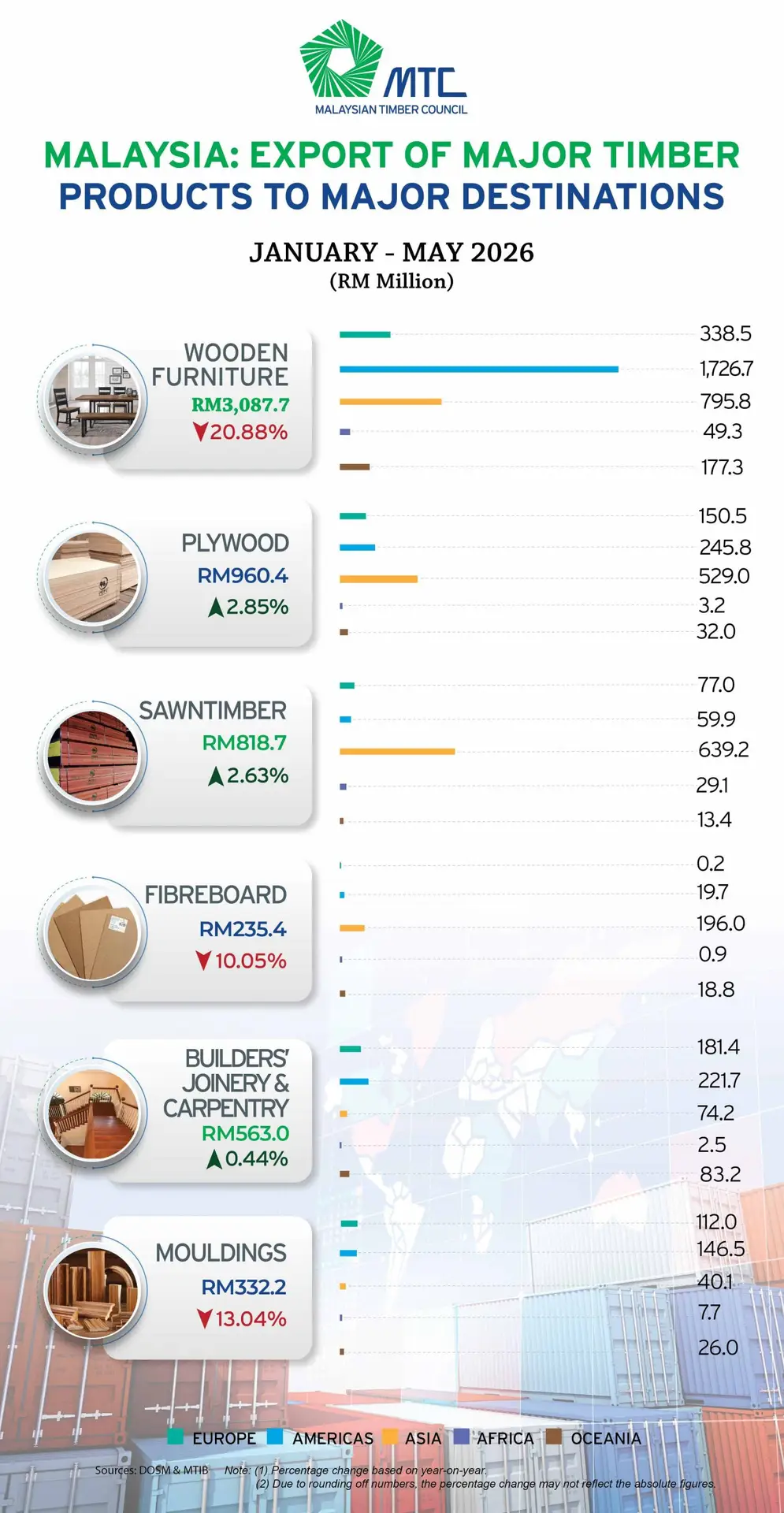
Medium Density Fibreboard (MDF)


Medium Density Fibreboard (MDF), the fifth largest revenue earner, contributed 5.3% to Malaysia’s receipts from export of timber products in 2009. For the same year, Malaysia exported 1 million m3 (cf. 1.1 million3 in 2008) of MDF worth RM1 billion (cf. RM1.1 billion in 2008), a drop of 8.8% in volume and 10.6% in value compared to 2008.

Japan was the largest importer of Malaysian MDF in 2009 with 137,768 m3 (cf. 160,396 m3 in 2008) valued at RM200.7 million (cf. 215.2 million in 2008), accounting for 19.4% of Malaysia’s total MDF exports. Given the recessionary conditions affecting consumption by construction and allied industries, Malaysia’s MDF exports to Japan dropped by 6.7% in 2009.

The unprecedented building and construction boom in the Middle East particularly in the oil-rich Gulf Co-operation Council (GCC) since the end of Iraq War in May 2003 has resulted in the region emerging as the single largest regional market for Malaysian MDF exports. In 2009, UAE with a market share of 11.3% in value terms, Iran (8.6%), Syria (6.4%) and Saudi Arabia (4%) were all ranked among the top ten export destinations for

Malaysian MDF. Notwithstanding, MDF exports to UAE in 2009 spiralled down by 39.1% in volume to 108,649 m3 and 38.9% in value to RM117 million. UAE was the second largest buyer of Malaysian MDF in 2009. With big state-owned developers mainly in Dubai plagued by liquidity crunch and a crisis of business confidence, the emirates’ property and realty sector crashed resulting in numerous mega projects being delayed, postponed or abandoned. As a result, consumption of MDF took a nosedive with many local joinery, interior-fit out and furniture manufacturing businesses left in a lurch over payment by developers and project owners. In contrast, Iran and Syria both recorded increases in MDF imports from Malaysia in 2009 by 757.5% and 23.9% respectively. Iran imported mainly value-added melamined and painted MDF boards while Syria opted for the cheaper plain boards.

Vietnam, the third largest export destination for Malaysian MDF in 2009, took in 130,481 m3 valued at RM93.8 million albeit a drop of 7.7% in volume and 15.5% in value amidst the global economic slowdown and financial crisis. In recent years, Vietnam has been importing huge quantities of wood products for downstream processing by its export-oriented wood-based and furniture industries.

The export of MDF from Malaysia to China fell from 66,801 m3 in 2008 (valued at RM55.1 million) to 44,191 m3 in 2009 (valued at RM31.2 million). An over-capacity in domestic MDF production coupled with dwindling overseas orders for China’s furniture, doors and flooring, the resulting fall in consumption has necessitated rationalisation in MDF imports.

Mouldings


Total export of Mouldings by Malaysia dropped from RM686.4 million in 2009 to RM744.1 million in 2008, a decrease of 7.7%. The Netherlands remained the biggest market although Malaysia’s exports have plunged by 30.8% year-on-year to RM114.5 million in 2009. Malaysia’s moulding exports to Japan, the second largest export destination, fell by 29.5% to RM107.5 million for the same year. The Netherlands and Japan contributed 16.7% and 15.7% respectively to Malaysia’s total moulding exports in 2009.

With the exception of Germany, the other countries in the Eurozone that ranked among the top ten export destinations for Malaysian mouldings such as Italy, Belgium and the UK all recorded negative 2009/2008 growth in import from Malaysia by 2.8%, 30.5% and 13.5% respectively. With the Eurozone entrenched in recession, importers of mouldings in these countries were affected by the lack of demand from the building and housing sector.

Interestingly, Australia and Germany both chalked up increases in import of Malaysian mouldings by 8% and 59.5% that amounted to RM105.2 million and RM85.3 million respectively in 2009. Australia and Germany contributed 15.3% and 12.4% respectively to Malaysia’s export of mouldings in 2009. After a drop in GDP in the first quarter, Australia managed to achieve a 1.4% real GDP growth for 2009 compared to 2.2% in 2008.

Asian countries like South Korea and Singapore, ranked sixth and ninth largest export destinations for Malaysian mouldings in 2009, also recorded positive growth of 50.9% and 43.4% amounting to RM38.9 million and RM16.7 million respectively. Increased uptake of mouldings such as flooring materials in South Korea was probably bolstered by the government’s stimulus package to spur building activities in the housing sector.

Veneer


In 2009, Malaysia’s export of veneer dropped to RM307.6 million, down by 29.3% compared to the previous year. Revenues from export of veneer contributed only a mere 1.6% to the total export earnings of Malaysian timber products in 2009.

South Korea has overtaken Taiwan as the top export market for Malaysia’s veneer in 2009 by absorbing RM108 million worth of veneer sheets, down by 17.9% compared to 2008. Taiwan and Japan, ranked second and third largest markets, imported Malaysian veneer valued at RM101 million (down by 23.2% cf. 2008) and RM32 million (down by 31.1% cf. 2008) respectively in 2009. Export of veneer by Malaysia to the three Far Eastern countries of South Korea, Taiwan and Japan contributed 35.1%, 33% and 10.4% respectively to Malaysia’s total export receipts from veneer in 2009. Malaysia’s export of veneer to China dropped by 47.4% to RM17.9 million due largely to the shutdown in production or closure by many of its export-oriented wood processing factories that consumed veneer. It was reported that some 30 – 50% of wood processing companies in the province of Shandong, Jiangsu and Zhejiang were closed due to the impact of the global economic slowdown.

With the exception of Germany and Australia, Malaysia’s top ten export destinations for veneer in 2009 were Asian countries. In a financially turbulent year for many nations, Germany was the only market to have recorded a positive growth of 28.3% year-on-year for Malaysian veneer exports.

Buiders’ Carpentry And Joinery (BCJ)


Earnings from export of Builders’ Carpentry & Joinery (BCJ) by Malaysia in 2009 dropped to RM987.8 million, down by 1.7% compared to 2008. BCJ contributed 5.1% to Malaysia’s total export earnings of timber products in 2009. In 2009, Japan overtook the US as the largest export market for BCJ by registering a 59.8% jump to RM132.5 million year-on-year despite faced with the deepest recession on record. Meanwhile, US slipped to fourth place with BCJ imports from Malaysia tumbling to RM78.9 million, down by 38.6% for the same year. The US was plagued by the sub-prime mortgage crisis and financial meltdown that caused widespread foreclosure of defaulted housing loans, which subsequently caused a collapse of the housing sector.

Malaysia’s export of BCJ to the Eurozone countries such as UK, France and Germany fell by 3.8%, 11% and 2.4% respectively in 2009 amidst the economic downturn. Going against the downward trend was Belgium which recorded a surge of 76.8% growth in BCJ imports from Malaysia to RM28.9 million.

For the same year, UAE and India also experienced growth in their import of Malaysian BCJ by 83.9% and 25.8% to RM74.7 million and RM30.8 million respectively. Despite the sudden collapse of UAE’s property and real estate sector, BCJ products such as flooring and doors were imported to complete building projects which had reached the interior-fit out stage. The growing affluence of the Indian middle class and increasing housing needs saw India importing more BCJ products for its active building construction sector.

Wooden Furniture


Wooden furniture was the largest export earner for the Malaysian timber industry in 2009, accounting for 32% of its total export receipts by netting RM6.2 billion, down by 9.7% compared to the previous year. Despite the sub-prime mortgage crisis and foreclosures as well as meltdown of its financial and banking system, the US remained Malaysia’s top furniture export market in 2009 with a market share of 31% but registered a drop of 4.2% to RM1.9 billion in 2009 from a year ago.

Japan, the second biggest furniture export destination with a market share of 11.4% chalked up a 17% increase in import from Malaysia valued at RM711 million in 2009. In comparison, Malaysia’s main competitors like China, Thailand and Taiwan experienced significant slide in exports to Japan that was hit with deep recession. Malaysia has been gaining prominence as an attractive import destination for furniture products among Japanese importers due to improving quality over the years.

The UK moved up a notch to become the third largest buyer of Malaysian furniture in 2009 with a market share of 8.1% and contributed RM509 million in export receipts, up by 17% amidst recessionary condition. In contrast, Australia slipped to fourth position and contributed 6.8% or RM428 million (down by 15% year-on-year) to total Malaysian furniture exports in 2009.

With export receipts down by 50.5% from RM343.3 million (2008) to RM170 million in 2009, UAE dropped from being the fifth to the seventh largest market for Malaysia’s furniture exports. This was largely attributed to the collapse of Dubai’s realty sector that led to a host of economic problems such as lack of liquidity in its banking sector, loss of business confidence and closure of companies. Subsequent exodus of unemployed expatriates returning home resulted in a lack of demand for low to mid-end furniture, which was dominated by Malaysian imports in the UAE market. The significant re-export trade of furniture by Dubai to surrounding countries was also adversely affected by the global economic slowdown.
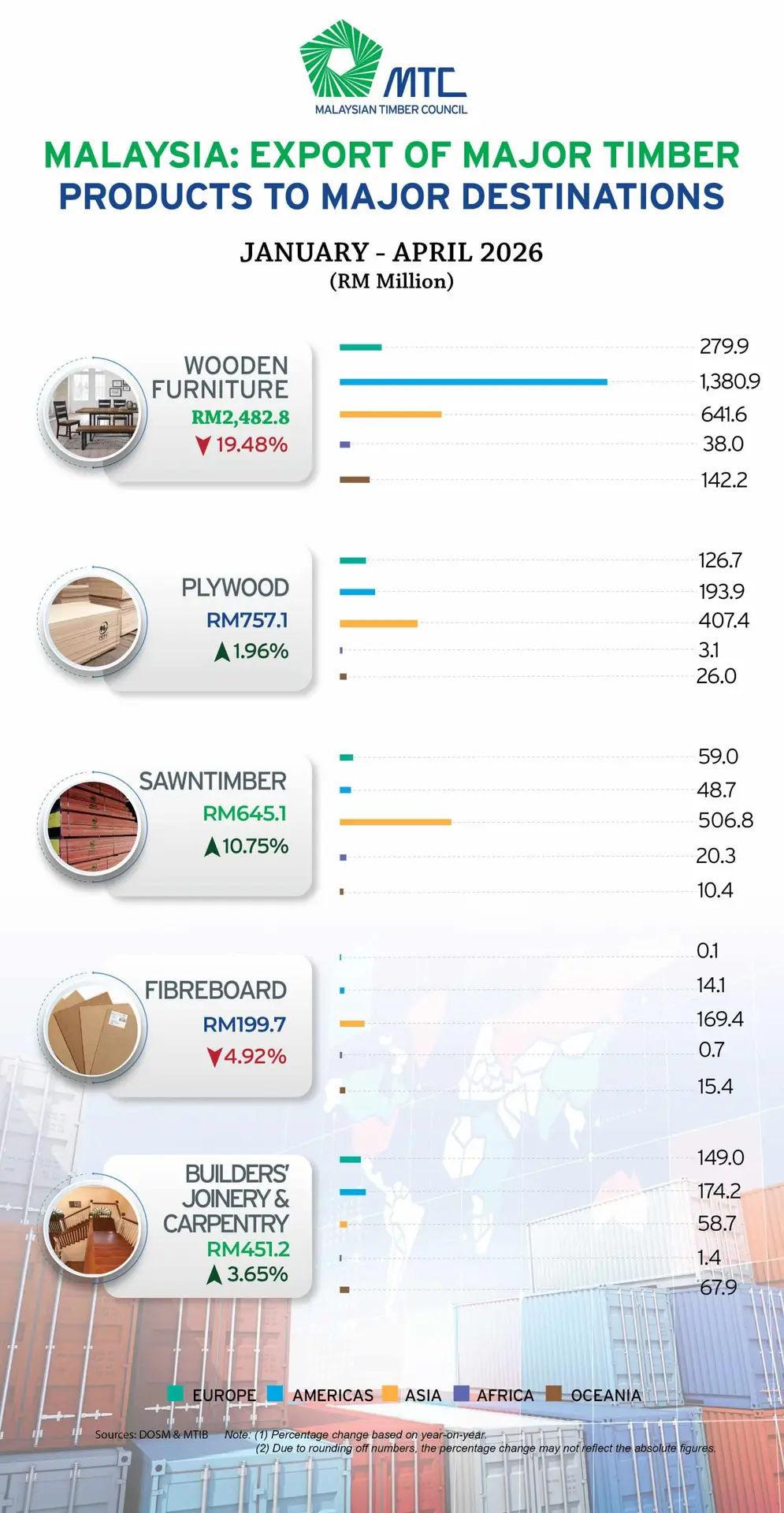
Timber Export Statistics

2008 Performance of the Malaysian Timber Trade

(Sources : MTIB)

Amidst the deepening economic crisis that began to spread globally in 2008, the Malaysian overall trade performance recorded a 6.8% growth where exports and imports increased by 9.6% and 3.3% each. Exports earnings for the year 2008 were valued at RM663.5 billion, of which 3.4% was contributed by the timber sector, a rise of 0.3% to RM22.79 billion from RM22.72 billion in 2007. The timber sector is the 5th largest export earner after electrical and electronic products; palm oil and palm oil-based products; and crude petroleum.

Heading the list of export earnings from major timber products in 2008 were Wooden Furniture with registered growth of 3.8% from RM6.7 billion to RM6.9 billion; Plywood valued at RM6.3 billion, an increase of 0.9% followed by Sawntimber and Logs with lower export revenue of RM3.1 billion (-2.6%) and RM2.1 billion (-2.6%) respectively. Medium Density Fiberboard (MDF) and Builders’ Carpentry and Joinery (BCJ) each contributed over RM1.0 billion respectively.

In terms of contribution towards the total exports of Malaysian timber products, Wooden Furniture accounted for 30.4%; Plywood – 27.8%; Sawntimber – 13.5%; Logs – 9.0%; Medium Density Fiberboard (MDF) – 5.1%, Builders’ Carpentry and Joinery (BCJ) – 4.4%, Mouldings – 3.3% and Veneer – 1.9%.

As for the leading export destinations for Malaysia’s timber products, Japan and USA maintained their position with a market share of 21.1% and 11.5% respectively while Korea was overtaken by India, whose imports from Malaysia accounted for 5.4%. Value wise, export receipts to Japan fell by 1.1% to RM4.8 billion and correspondingly, USA fell by 10.3% to RM2.6 billion. India has emerged as an important market to watch as its imports soared by 17.2% to RM1.2 billion.

From a market perspective, while the traditional markets of the USA, Japan and the EU continued to absorb more that a third of Malaysia’s total exports of timber products in 2008, the emerging markets such as China, India, Poland, the UAE, Saudi Arabia, Brazil, Russia, Kazakhstan and Ukraine have shown significant expansion both in terms of growth and market share.

Logs


Logs, Malaysia’s fourth largest export item made up 9.0% of Malaysia’s total timber exports in 2008. The stagnant effects of the global downturn can be demonstrated from the export performance of Malaysian logs where export revenue remained at RM2.1 billion while decreasing 6% in volume to 4,368,403 m3.

India maintained its past year’s top ranking as the largest market for Malaysian logs, accounting for 43.1% of Malaysia’s total log exports in 2008. Export earnings from India grew by 13%, equivalent to RM886.7 million. While other traditional markets like China and Japan reduced their import of Malaysian logs, India increased theirs by 19.8% amounting to 1,891,807 m3. 

In 2007, China imported RM506.3 million worth of logs. In 2008, affected by the economic downturn, the total value of exports to China declined

by 26.8% to RM370.5 million,  accounting for 18.0% of the total exports of Malaysian logs. Volume wise, China imported 697,901 m3 of Malaysian logs in 2008, a big drop of 41% if compared to recorded figures of 1,183,286 m3 in 2007.

Japan, the third largest market for Malaysian logs also ended 2008 on a low note, with exports falling in value by 12.5% to RM310.4 million. Despite the fact that the volume of logs imported by Japan was reduced by 16.7% to 589,140 m3, the Japanese market still accounted for 15.1% of Malaysia’s log exports.

Sawntimber


The export performance of sawntimber had also been on a declining slope, although it contributed 13.5% towards the export earnings of Malaysian timber products. For 2008, Malaysia’s export of sawntimber slackened slightly both in volume and value terms by 0.4% to 2,478,611m3 and by 2.6% to RM3.1 billion compared to 2007’s export receipts of RM3.2 billion.

As the largest buyer of Malaysian sawntimber, Thailand continued its uptake with export earnings of RM489.5 million which represents an increase of 4.1% over 2007. It is also interesting to note that in volume terms, this represents an increase of 4% amounting to 657,237 m3. Exports to Thailand accounted for 15.9% of Malaysian total exports of sawntimber. 

With total imports of RM412.0 million, The Netherlands was the second largest market, accounting for 13.4% of Malaysia’s total sawntimber 

exports. However, the value of export receipts from The Netherlands decreased by 7.5% compared to the corresponding period in 2007. While the value of exports went down, there was a slight increase of 2.8% in the volume of sawntimber imported, which was recorded at 138,058 m3.

Japan’s exports receipts declined 12.2% by value to RM224.3 million, accounting for 7.3% of overall Malaysian sawntimber exports. In volume terms, Japan’s import of Malaysian sawntimber fell to 131,194 m3, a drop of 6.9% compared to 2007.

Plywood


In 2007, export of Malaysian plywood plummeted both in value and volume terms by 11.7% to RM6.3 billion and by 11.8% to 4,372,034 m3 respectively. However, in 2008, it can be seen that this sharp decline has come to an end and that the exports of Malaysian plywood is slowly recovering, increasing 0.9% in value to RM6.3 billion and 5.8% in volume to 4,624,553 m3. Plywood remains the second biggest earner of Malaysian timber exports for 2008, accounting for 27.8% of total timber exports.

Accounting for 46.7% of Malaysian exports of plywood, Japan maintained its lead as the largest market for Malaysian plywood. However, exports receipts from Japan fell by 0.8% to RM3.0 million whereas the volume of exports to Japan rose by 5.4% to 2,041,790 m3.  

Trailing behind Japan, South Korea contributed 11% of exports of Malaysian plywood with import figures of 606,431 m3 valued at RM697.5 million. This reflected an increase of volume by 1.3% and a decrease in value by 4.6% if compared to earnings of 2007.

With 7.5% of market share, Taiwan claimed the rank of Malaysia’s third largest export destination. Taiwan’s 2008 import takings were valued at RM476.2 million, a recorded jump of 10.5% from 2007 and continued this upward trend where volume of plywood imports increased by 12.5% to 397,437 m3.

Medium Density Fibreboard (MDF)


Medium Density Fiberboard (MDF) exports have also not been spared by the global economic downturn as 2008 exports earnings from MDF dropped by 2.1% to RM1.2 billion. The volume of MDF exported however rose by 0.7% to 1,136,182 m3. Overall, the MDF sector contributed 5.1% to the total of Malaysia’s timber exports in 2008.

Japan overtook UAE by accounting for 18.6% of Malaysian MDF exports, making it the leading buyer for 2008. Interestingly, while the value of exports to Japan increased by 1.6% to RM215.3 million, the volume exported dropped by 10.6% to 160,396 m3.

In 2008, 16.6% of exports of Malaysian MDF went to UAE. Previously the leading market destination, export receipts from UAE worth RM191.6 million had decelerated by 17%. The volume of MDF exported also fell 12.3% to 178,524 m3. The decrease in exports could be due to the slowing down of the construction boom attributed to the global effects of the subprime mortgage crisis.

Vietnam remained the third largest buyer of Malaysian MDF with import growth of 10.5% valued at RM111.0 million. At 141,391 m3, exports to Vietnam amounted to 9.6% of Malaysia’s total MDF exports, a rise of 21.3% over 2007.

Mouldings


Compared to the other timber products, Malaysia’s export of mouldings proved to be most affected by the global recession, posting a dismal performance for the year 2008. While it contributed 3.3% to the overall export earnings of Malaysia’s timber products, export receipts from Mouldings shrunk by 15.4% in volume terms to 289,288 m3 valued at RM744.1 million, a sharp fall by 18.7% in value terms when compared to 2007.

Although exports to The Netherlands dropped 8.3% to 44,900 m3, the country maintained its position as Malaysia’s largest export destination for mouldings for the second consecutive year. The Netherlands contributed 22.3% to Malaysia’s total export of mouldings for 2008. However, the value of imports fell 13.2% with earnings of RM165.6 million.

With export revenue of RM152.5 million, the value of exports to Japan shrunk by 9% and volumewise, by 17.8% to 57,882 m3.

This downward trend can also be seen in the export figures from Australia where exports of mouldings dropped by 10.4% in volume terms to 41,680 m3 and down 18.6% in value to RM 97.4 million.

For the period under review, Japan and Australia accounted for 20.5% and 13.1% of Malaysia’s total mouldings exports respectively.

Veneer


Exports of veneer in 2008 ended on a positive note where a growth of 11.6% in value to RM435.3 million was recorded. The same growth was noticeable in the volume of exports by 23.8% from 333,815 m3 to 412,948 m3. Contribution of veneer to total Malaysian exports amounted to 1.9% in 2008.

Taiwan remained the largest buyer of veneer with imports worth RM132.3 million (up by 22%). Accounting for 30.4% of Malaysia’s overall veneer exports, the volume of exports to Taiwan also rose correspondingly by 32.7% to 133,983 m3.

South Korea also emerged as a strong buyer for Malaysian Veneer as it registered a positive growth of 1.7% in value over 2007, translated into RM131.6 million. At 132,822 m3, South Korea increased its imports by 16.1% in volume terms and accounted for 30.2% of Malaysia’s total mouldings exports.

With 10.7% market share, exports to Japan fell by 14.3% in value over 2007 which amounted to RM46.5 million. Import volume to Japan also underwent a decline of 16.3% to 28,420 m3.

Buiders’ Carpentry And Joinery (BCJ)


The export receipts of Malaysia’s Builders’ Carpentry and Joinery (BCJ) for 2008 amounted to RM1.0 billion, lower by 1.2% compared to export receipts in December 2007. It accounted for 4.4% of Malaysia’s total timber based exports.

Heading the list of top ten export destinations for BCJ in 2008, USA registered a decrease of export receipts by 39% or RM128.6 million. The United Kingdom followed closely with export revenue of RM120.3 million, up by 1.9% and Australia with proceeds billed at RM83.8 million which represented an increase of 3.8%.

As for market share, the USA and UK each accounted for 12.8% and 12.0% while both Australia and Japan took 8.3% each followed by Singapore at 6.6%.

Wooden Furniture


Once again, with a contribution of 30.4% translated into earnings amounting to RM6.9 billion, Wooden Furniture tops the list of Malaysia’s export of major timber products for 2008. For the period under review, it is worth noting that export receipts of wooden furniture rose 3.8% over the past year.

Despite the subprime mortgage crisis, USA continued to be the leading market destination for Malaysian wooden furniture with an uptake of RM2.0 billion, up 1.6% when compared to imports in 2007. USA’s market consumption of Malaysian furniture exports amounted to 29.9% in 2008.

For the same period under review, Japan fell 2.2% in export receipts worth RM607.9 million, accounting for 8.8% of total Malaysian wooden furniture exports. Meanwhile, exports to Australia amounted to 7.3%, showing a sharp drop of 8.4% to RM503.5 million.

Timber Export Statistics

2007 Performance of the Malaysian Timber Trade

(Sources : MTIB)

The timber industry in Malaysia retracted slightly in 2007 amidst intense global competition, rising fuel prices and raw material constraint. Malaysia’s export of timber products recorded a figure of RM22.7 billion, down 3.1% over 2006’s earnings of RM23.3 billion. The shortfall was attributed to the global effect of the US subprime mortgage crisis which slowed down demand in most of Malaysia’s export markets. The timber trade sector accounted for 3.7% of Malaysia’s total export earnings and was the fourth largest export earner after electrical and electronic products; palm oil and palm oil-based products; and crude petroleum. Overall, the timber trade contributed 4% of the nation’s GDP.
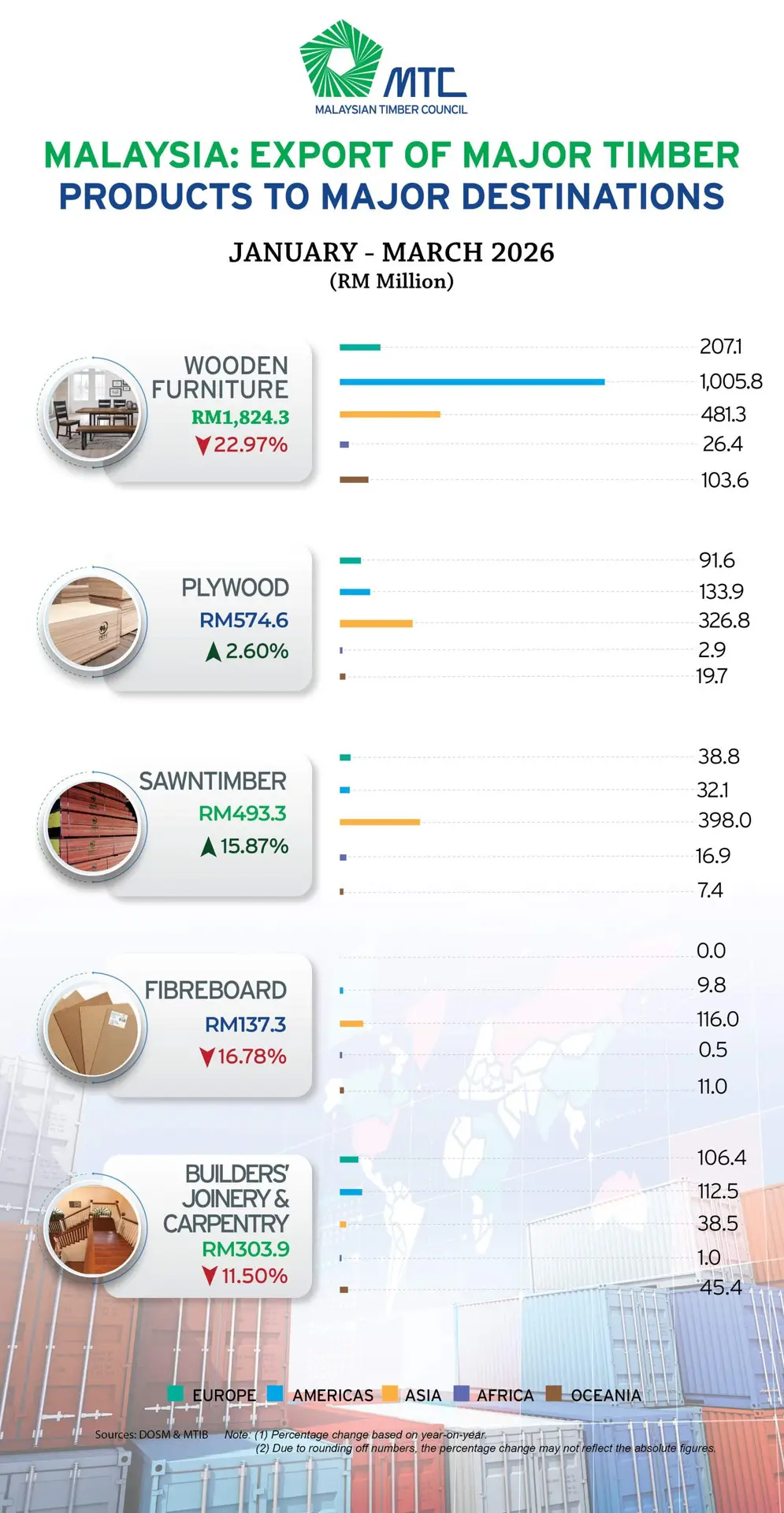
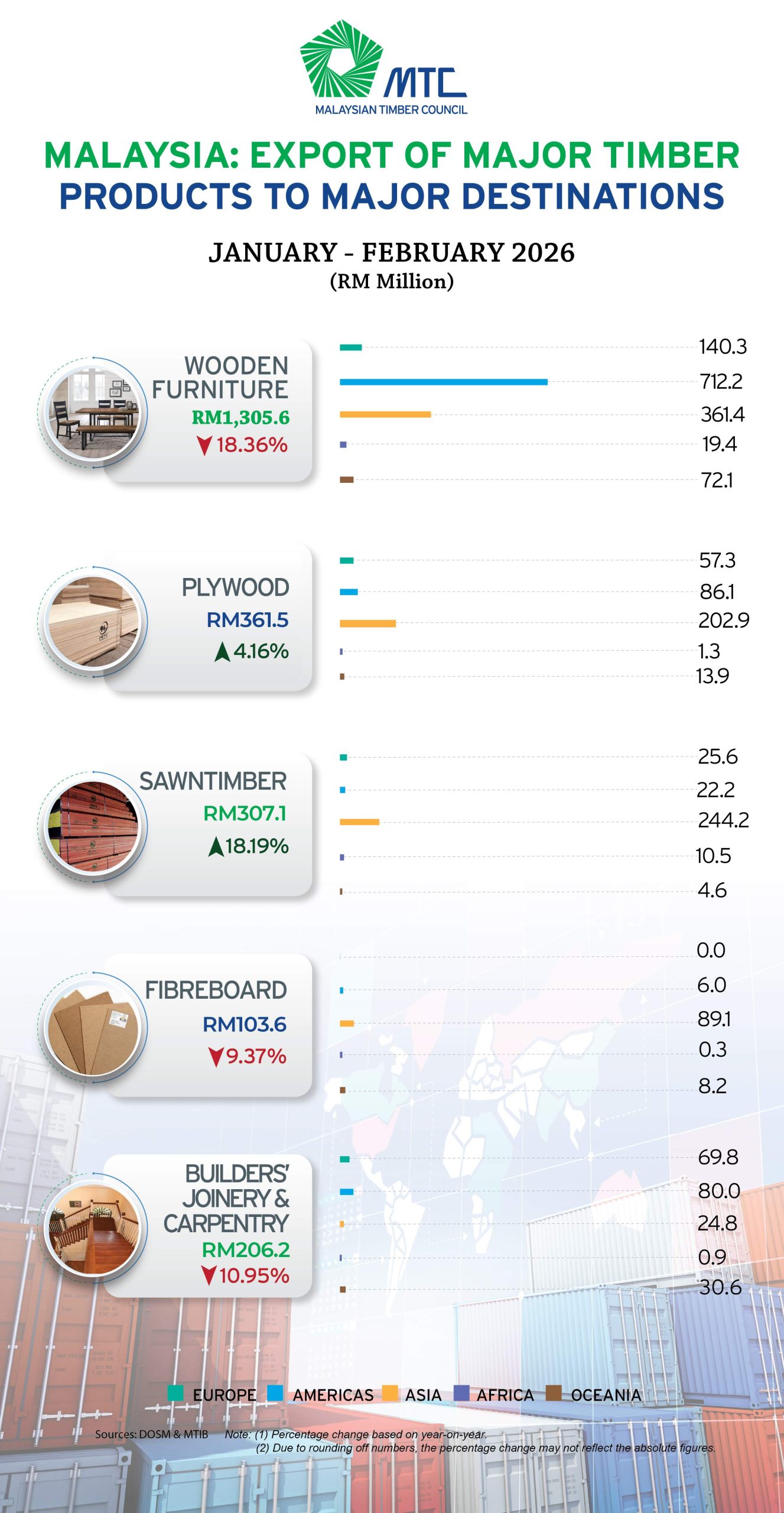
Wooden furniture topped the chart as the leading export item with RM6.7 billion or 29.3% of total timber based exports in 2007. This was followed by plywood and sawntimber with total exports amounting to RM6.3 billion or 27.6% and RM3.2 billion or 13.9% respectively. Logs contributed RM2.1 billion while Medium Density Fiberboard (MDF) and Builders’ Carpentry and Joinery (BCJ) each contributed over RM1.0 billion respectively.

Japan, USA and Korea remained the top three export markets for Malaysia’s timber products. In 2007, 21.4% of Malaysia’s total timber exports valued at RM4.9 billion went to Japan. USA remains the second most important market, contributing 12.8% to the total of Malaysia’s timber export earnings. However, the slowdown in the US market also affected exports of major products such wooden furniture, plywood and joinery products and value of exports to USA amounted to RM2.9 billion, a decrease of 18.2% over the previous year. At third place, Korea accounted for RM1.1 billion or 5.0% of exports from Malaysia.

Logs


The slowdown in the timber industry felt in 2007 could be clearly demonstrated by the declining numbers in the export of Logs. Export receipts from logs fell by 6.6% to RM2.1 billion while volume decreased by 2.6% to 4,647,429 m3 in 2007. As Malaysia’s fourth largest export item, logs contributed 9.3% of Malaysia’s total timber exports in 2007.

India remained as the largest market for Malaysian logs. The country accounted for 37.2% of Malaysia’s total log exports in 2007. Exports to India grew by 13.3% to RM784.7 million in 2007. This is a big increase from the RM692.3 million registered in 2006. Volume wise, India imported 1,579,118 m3 of Malaysian logs, a significant increase of 13%.

In 2007, China imported RM506.3 million worth of logs. Although having taken over Japan’s position as the second largest market for Malaysian logs, imports have decreased 3.5% in terms of value. Volume of logs purchased has also decreased 0.4% to 1,183,286 m3. This was attributed to escalating timber prices especially imported timbers and slow development in the Chinese housing and commercial sector. The Chinese market accounted for 24% of Malaysia’s log exports.

China’s downward trend was also mirrored by Japan. In 2007, Japan’s intake of Malaysian logs declined sharply by 33.6% to RM354.8 million in value terms and 31.8% to 706,843 m3 in volume compared to 2006.

Sawntimber


For the period under review, Malaysia’s export of sawntimber weakened both in volume and value terms by 4.5% to 2,487,340 m3 and by 3.6% to RM3.2 billion compared to the previous year. Despite this, sawntimber was the third largest export item, contributing 13.9% of Malaysia’s total timber based exports.

In 2007, Thailand regained their position as the largest buyer of Malaysian sawntimber with export receipts amounting to RM470.4 million, a healthy increase of 6.0% over the past year whereas volume uptake rose by 3.7% to 631,752 m3.

With an uptake of RM445.4 million, 2006’s largest buyer The Netherlands, slid to second place with a sharp decrease of 20.7% in terms of value. Naturally, this downward incline also affected the volume of sawntimber exported to The Netherlands where it fell by 31.7% to 134,326 m3 in 2007.

Japan maintained its rank as Malaysia’s third largest market for sawntimber. However, exports to Japan fell by 3.8% to RM237.3 million followed by a drop of 5.7% in volume to 140,927 m3.

In terms of market share, Thailand accounted for 14.9% of Malaysia’s total sawntimber exports while The Netherlands and Japan took 14.1% and 7.5% respectively.

Plywood


The Malaysian plywood sector took a turn for the worse in 2007 where the export of plywood declined both in value and volume terms by 11.7% to RM6.3 billion and by 11.8% to 4,372,034 m3 respectively over 2006. Notwithstanding the global market slowdown, plywood was Malaysia’s second largest export item contributing 27.6% of the country’s total timber based exports.

Japan continued to be the largest market for Malaysian plywood, accounting for 47.4% of Malaysian plywood exports last year. After five years of positive growth, volume of exports to Japan valued at RM2.98 billion decreased by 23.3% to 1,937,933 m3. This is mainly due to Japan’s revised Building Standard Act, lower housing starts and increased freight prices.

With 11.6% and 6.9% market share each, South Korea and Taiwan

ranked as the second and third largest export destination of Malaysian plywood in 2007. Undergoing a robust growth, South Korea increased their import volume by 23.8% to 598,680 m3 valued at RM730.8 million (up 21.6%). This growth spurt was not enjoyed by Taiwan whose import volume shrunk by 7.4% to 353,183 m3 and 3.5% to RM430.8 million in terms of value.

Medium Density Fibreboard (MDF)


Although export volume dropped by 8.7% to 1,125,975 m3, Malaysia’s Medium Density Fiberboard (MDF) sector showed an improved performance in 2007 with export takings recorded at RM1.2 billion, an increase of 3.1% compared to 2006. Overall the MDF sector contributed 5.2% to the total of Malaysia’s timber exports in 2007.

With a record breaking increase of value by 78% translating into export receipts worth RM230.8 million, UAE dethroned Japan by acquiring 19.5% of Malaysian MDF exports, making it the leading buyer for 2007. Correspondingly, the volume of MDF exported to UAE increased by an impressive 58.2% to 203,536 m3. This big jump in Malaysian exports is attributed to the construction boom that UAE has been experiencing in the last five years.

Decreasing 1.9% in value, Japan was Malaysia’s second largest buyer of MDF with imports worth RM212.0 million. At 179,414 m3, export to Japan

amounted to 17.9% of Malaysia’s total MDF exports, a positive increase of 11.9% over 2006.

At third place, Vietnam accounted for 8.5% of Malaysia’s total MDF exports, with import takings valued at RM100.5 million, a decrease of 14.6% from 2006. In terms of volume, there had been a decrease of 28.4% to 116, 530 m3 of Malaysian mouldings when compared to the previous year. However, from only RM19.7 million of import recorded in 2000, the uptake by Vietnam has skyrocketed five-fold to RM100.5 million in 2007.

Mouldings


The mouldings sector continued to perform well in 2007, contributing 4% of Malaysia’s total timber based exports last year. While the total export of mouldings surged by 14.9% amounting to RM915.3 million, export volume dropped by 16.9% to 341,818 m3 when compared to the previous year.

In 2007, The Netherlands usurped Japan’s traditional position as the largest export destination of Malaysian mouldings. The country accounted for 20.8% of Malaysia’s total mouldings exports in 2007, an increase in value by a staggering 38.5%, amounting to RM190.8 million. Likewise, the upward trend could also be seen in the increase of volume where The Netherlands bought 48,954 m3 (up 16.6%) of Malaysian mouldings in 2007.

Trailing behind at second place, Japan imported 70,397 m3 of Malaysian

mouldings valued at RM167.5 million, an increase of 1% from 2006. This translated to 18.3% of Malaysia’s total export of mouldings for the period under review.

Australia remained Malaysia’s third largest buyer of mouldings with imports worth RM119.6 million. Proving itself as another important market for Malaysia, Australia registered a positive growth of 14.8% in value over 2006, accounting for 13.1% of Malaysia’s total mouldings exports.

Buiders’ Carpentry And Joinery (BCJ)


In 2007, total export of Builders’ Carpentry and Joinery (BCJ) products slid by 0.9% to RM1.0 billion, accounting for 4.5% of Malaysia’s total timber based exports. However, wooden flooring made impressive export gains and together with wooden door and frames, accounted for 71.3% of the country’s total BCJ exports in 2007.

In 2007, export of wooden doors and frames increased by 3.7% to RM366.2 million, making up 36% of total BCJ exports. USA was the leading importer with an uptake of RM108.5 million. UK and Australia retained their ranking as the second and third largest importers with total imports amounting to RM100.7 million and RM35.0 million respectively.

As for wooden flooring, the product made up 35.3% of BCJ’s total exports, registering a 9.2% hike to RM359.6 million. In 2007, the largest market for Malaysian wooden flooring was Denmark with import value of RM53.4 million. Trailing behind was USA and Australia with imports of RM52.7 million and RM39.0 million respectively.

Overall, USA remained the leading market for Malaysian BCJ with an uptake of RM210.9 million, down 32.1% when compared to imports in 2006. The UK maintained their position as Malaysia’s second largest market with purchases worth RM118.1 million, an encouraging rise in value by 21%. Australia replaced Japan with imports of RM80.7 million, an increase of 20%.

Wooden Furniture


In 2007, Malaysia ranked within the top 10 furniture exporters in the world. The demand for Malaysian furniture had increased significantly over the last few years, with Malaysian furniture exported to over 180 countries. From 2000 – 2007, Malaysian furniture exports surged an impressive 49.6% to RM6.7 billion in 2007.

With total exports of RM6.7 billion, wooden furniture was the largest contributor accounting for 29.3% of Malaysia’s total timber based exports. For the period under review, export receipts of wooden furniture rose 4% compared to the corresponding period in 2006.

USA remained as the largest single market for Malaysian wooden furniture. The country accounted for 29.7% of Malaysia’s total wooden furniture exports in 2007. However, exports to USA in 2007 decreased by 11.2% to RM2.0 billion compared to the previous year. Exports to other major countries such as Japan, Australia and UK were recorded at RM621.6 million, RM549.8 million and RM494.3 million respectively.